
Every presenter knows the feeling: twenty minutes in, the room goes quiet in the wrong way. Eyes drift to laptops, the back row checks their phones, and you realise you are talking at people who stopped listening a while ago. Losing a room is rarely about bad content — it is about the format. A one-way monologue simply cannot compete with everything else fighting for your audience's attention.
The fix is not to talk louder or add more slides. It is to give people something to do. Below are 15 audience engagement techniques that actually work, grouped by the three moments of any talk — and the short version of the psychology behind why they work. If you want the beginner primer first, start with how to make your presentations interactive; for a deeper catalogue of interactive slide formats, see our 15 ways to make your presentation interactive.
First, understand why attention fades
Human attention is not a flat line — it decays. Research on attention span shows focus dips within minutes of passive listening, and every dip is a moment you can lose someone for good. The single most reliable way to reverse a dip is to make the audience act: the moment they vote, type, or answer, their attention resets to full.
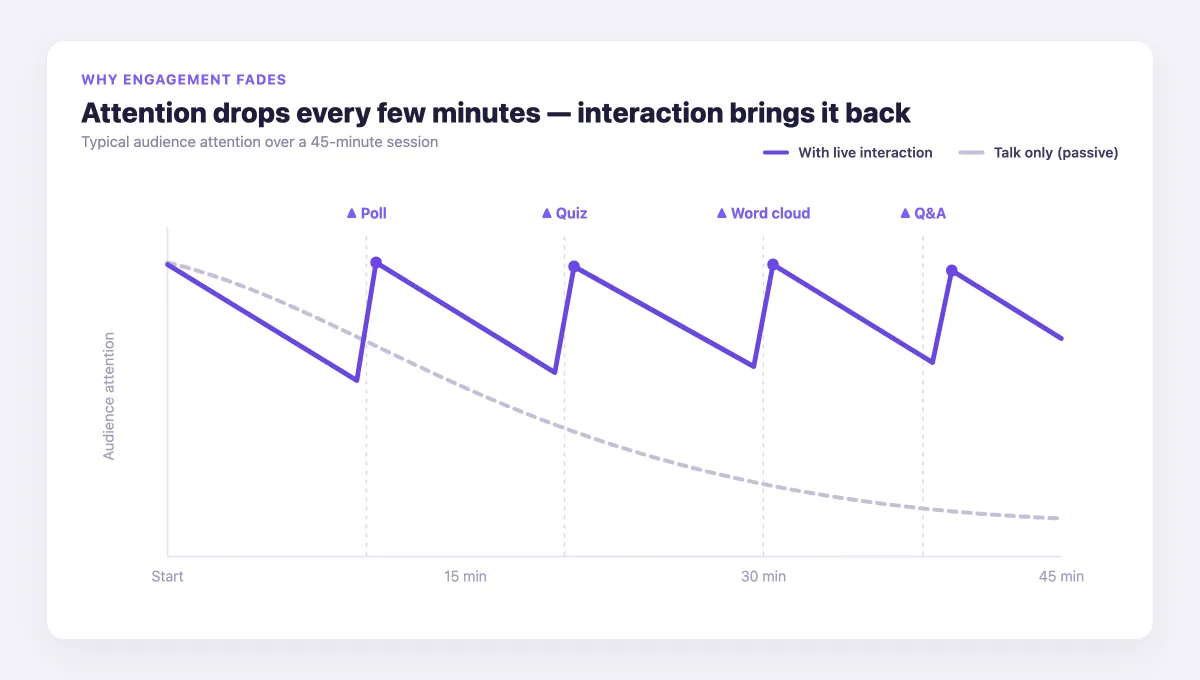
That is the whole idea behind interactive tools like EngageSlide: instead of hoping people stay with you, you build in regular participation points — a poll here, a quiz there — that keep resetting the attention curve. The techniques below are simply the best of those participation points, placed where they do the most good.
It helps to be clear about what real engagement is. It is not the same as entertainment. A funny anecdote earns you thirty seconds of attention; asking the room a question they have to answer earns you their focus and tells you something you did not know. True engagement is two-way — it changes both the audience's state and yours. Every technique that follows passes that test: the audience contributes, and you get information back you can act on live.
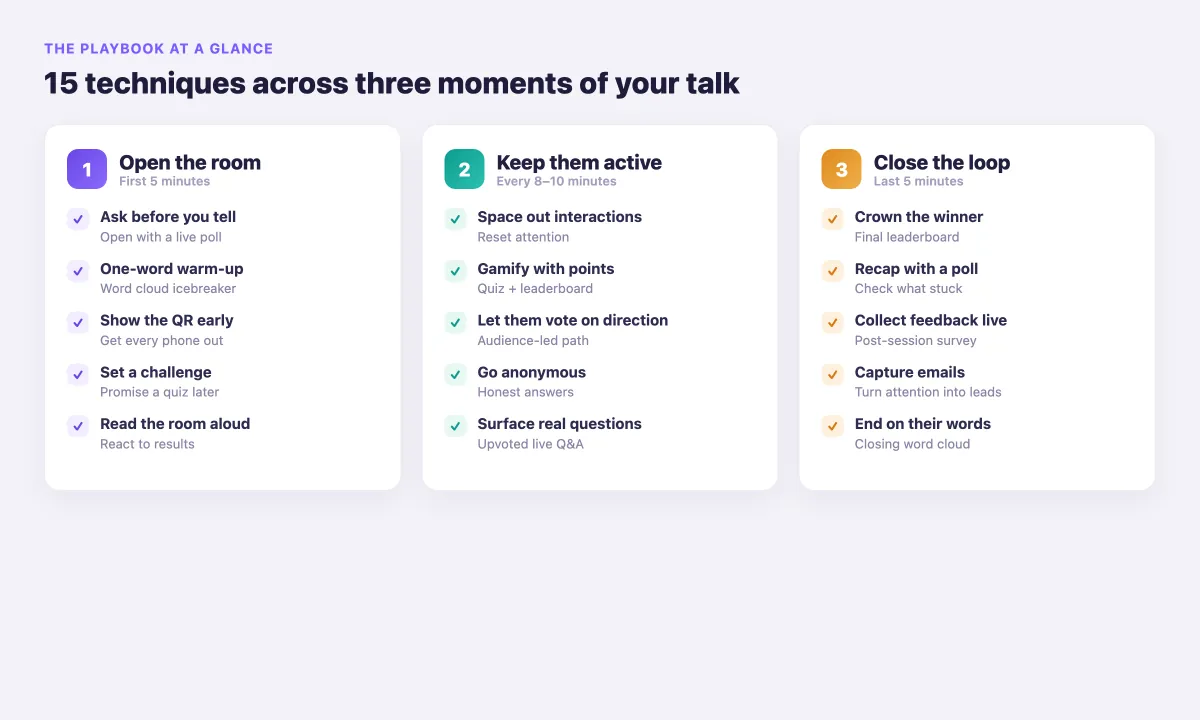
Open the room (your first 5 minutes)
The opening sets the contract: is this a lecture, or a conversation? Signal "conversation" fast and people lean in for the rest of the session.
- 1. Ask before you tell. Open with a live poll instead of an agenda slide. A question like "What's your biggest challenge with X?" makes people invest an opinion in the first 60 seconds.
- 2. Run a one-word warm-up. A live word cloud — "Describe your week in one word" — is a low-stakes way to get everyone's thumb on their phone before the stakes rise.
- 3. Show the join QR early. Put the QR code up while people are still settling. The goal is simple: every phone open and pointed at your session, not at email.
- 4. Set a challenge. Promise a quiz with a leaderboard at the end. A tiny bit of anticipated competition keeps people paying attention so they can win.
- 5. Read the room out loud. When early results appear, react to them: "Interesting — most of you picked B, so let's dig into that." This proves their input actually changes what you do.
Keep them active (every 8–10 minutes)
The middle is where talks die. The rule of thumb: never go more than about ten minutes without inviting participation. These five techniques carry the body of your session.
- 6. Space out your interactions. Plan a participation point roughly every 8–10 minutes so you reset attention before it bottoms out, not after.
- 7. Gamify with points and a leaderboard. Turning a knowledge check into a scored quiz taps straight into peer learning and friendly competition — people concentrate far harder when a score is on the line.
- 8. Let the audience steer. Use a poll to choose which topic to cover next. Handing over even small decisions makes people feel ownership of the session.
- 9. Go anonymous for honesty. For sensitive questions, anonymous polls and Q&A surface what people really think instead of the polite, expected answer — and honest data makes your talk sharper.
- 10. Surface the real questions. Run a live Q&A where people submit and upvote questions. The best questions rise to the top by votes, not by who is loudest or most senior.
Engagement is not a personality trait you either have or don't. It is a series of small, deliberate invitations to participate — and anyone can design them into a talk.
Close the loop (your last 5 minutes)
How you finish decides what people remember and whether they act. Do not waste the closing on a plain "thank you" slide.
- 11. Crown a winner. If you ran a quiz, reveal the final leaderboard. It ends the session on a spike of energy and gives people a reason to have stayed sharp.
- 12. Recap with a poll. A quick "Which idea will you try first?" poll doubles as a memory aid — retrieving the answer helps it stick.
- 13. Collect feedback while it's warm. Launch a short post-session survey before people leave. In-the-moment feedback beats a next-day email by a wide margin.
- 14. Capture emails and turn attention into leads. If it fits your goal, ask for an email in that closing survey so engaged attendees become people you can follow up with.
- 15. End on their words. A closing word cloud — "One thing you're taking away" — sends people out having contributed the final thought, not just heard yours.
The mindset shift that ties it together
Notice what all fifteen techniques have in common: none of them require you to be a more charismatic speaker. They work because they change the audience's role from spectator to participant. Every poll, quiz, word cloud, and Q&A is a small moment where the room does something instead of watching — and each of those moments buys back the attention a monologue quietly loses.
You do not need all fifteen at once. Pick one from each moment — an opening poll, a mid-session quiz, and a closing feedback survey — and build from there. The tools are all in one place in EngageSlide, so adding a participation point is a matter of dropping in a slide, not rebuilding your deck. Try three techniques in your next talk and watch the difference: heads up, phones pointed at your screen, and a room that stays with you to the last slide.