

A student who guesses B and gets it right scores exactly the same as a student who knew B was right. On a normal multiple-choice quiz, those two answers look identical in your gradebook, yet they mean very different things for what you teach next. Confidence-based marking fixes that by asking one extra question with every answer: how sure are you? This article explains the research behind it, why it changes how students think, and how to bring it into a live lesson with a betting round in EngageSlide.
What is confidence-based marking?
Confidence-based marking (CBM), also called certainty-based marking, scores an answer on two things: whether it is correct, and how certain the student said they were. The best-known scheme comes from Tony Gardner-Medwin, a physiology professor at University College London, who has used it with medical and science students since 1994. His certainty-based marking self-tests have served many thousands of practice sessions.
The rule is simple. After choosing an answer, the student picks a certainty level from 1 to 3:
- Level 1 (low). +1 if correct, 0 if wrong.
- Level 2 (medium). +2 if correct, −2 if wrong.
- Level 3 (high). +3 if correct, −6 if wrong.
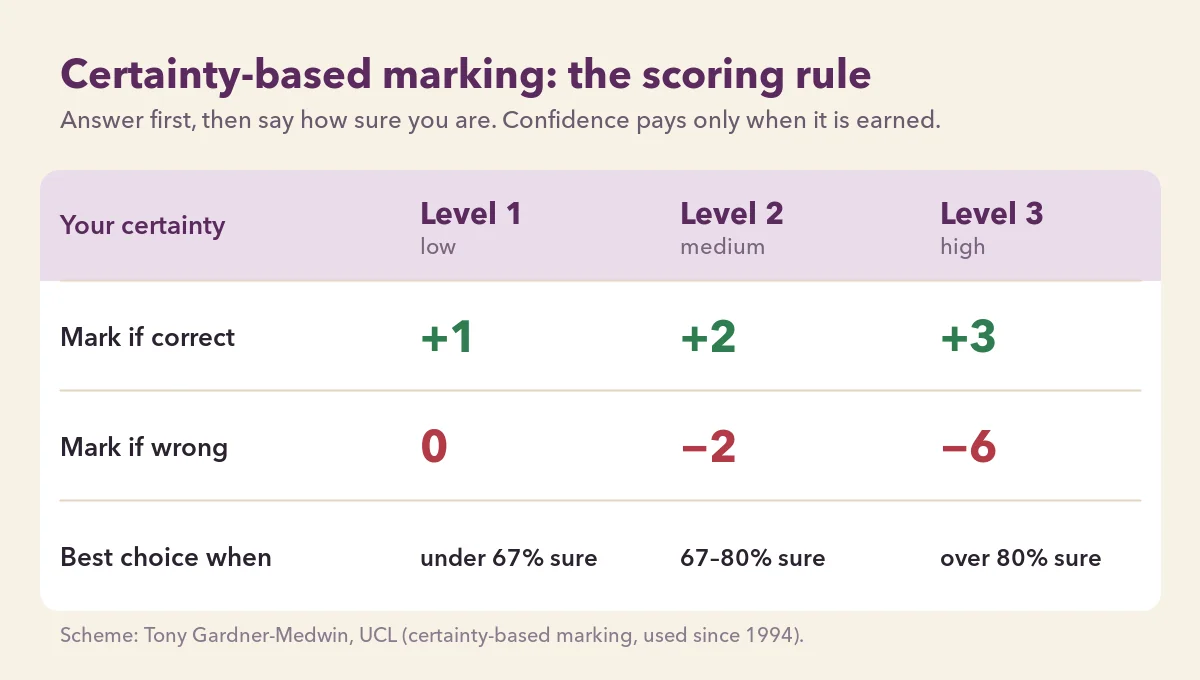
The penalties are what make the scheme work. Level 3 is only worth choosing if you are more than about 80% sure; between roughly 67% and 80% the best choice is level 2; below that, level 1 is safest. A student who simply maximises their score has to estimate their own certainty honestly. Bluffing costs points, and so does false modesty.
Why betting on answers helps students learn
It trains metacognition
Knowing whether you know something is a skill of its own. Psychologists call it metacognition, and it predicts how well students plan their revision. A normal quiz never asks for it. CBM asks for it on every single question, so students practise judging their own understanding dozens of times per session instead of once, on exam day.
It separates knowing from guessing
On a four-option question, a pure guess is right 25% of the time. Under CBM, guessing at a high certainty level loses points on average, so students learn quickly that "I'm not sure" is a legitimate, even smart, answer. A correct answer at high certainty now really means the student knows it.
It exposes confident misconceptions
The most dangerous answer in a classroom is not "I don't know". It is a wrong answer given with full confidence. Those are the misconceptions students will carry into the exam, and into their jobs, without questioning them. CBM flags them directly: a −6 is a loud signal that a student believes something false. Gardner-Medwin describes this warning signal as one of the main benefits for self-study.
It rewards careful thinking
Because certainty has a price, students pause to look for reasons. Can I justify this answer? Could another option also fit? That short moment of reflection is where a lot of the learning happens, and it costs you no extra teaching time.
Bringing confidence into a live lesson with a wager quiz
Classic CBM runs as a self-test on a computer. In a classroom or training room you can get most of the same benefit, plus a lot more energy, with a betting round. EngageSlide's Bet / Wager question asks every player to bet points before the answer options appear. If you have never used it, our complete guide to the wager quiz walks through the setup step by step. Here we focus on how to configure it so that it behaves like confidence-based marking.
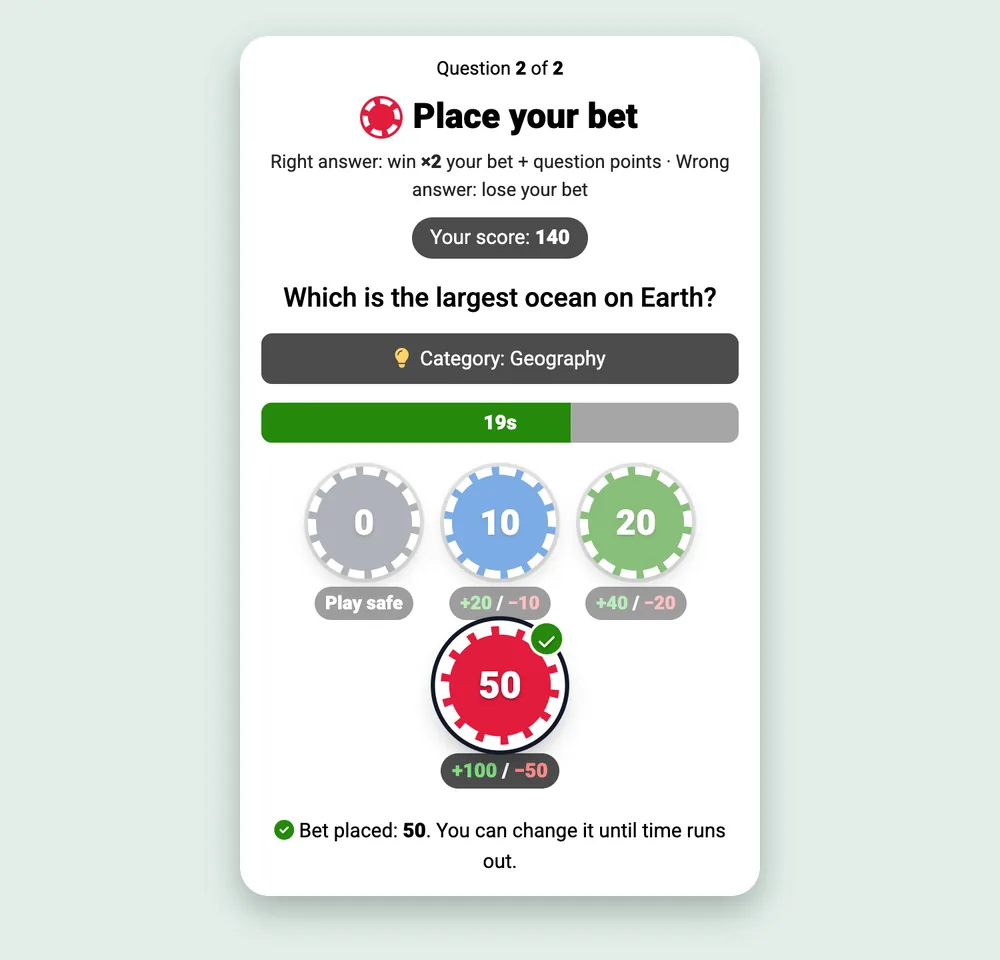
Map the chips to certainty levels
Each chip a student can pick works like a certainty level:
- The 0-point "play safe" chip = low certainty. Turn on the play-safe option. A right answer still earns the normal question points, and a wrong answer costs nothing, exactly like CBM level 1.
- A small chip = medium certainty. For example 50 points when questions are worth 100.
- A large chip = high certainty. For example 150 points. Big win if right, a real loss if wrong.
Choose the payout carefully
The payout multiplier decides how sure a student must be before a bet is worth it. A bet pays off on average only if the chance of being right is above 1 ÷ (1 + multiplier):
- ×1: bet only if you are more than 50% sure.
- ×1.5: more than 40% sure.
- ×2: more than 33% sure.
- ×3: more than 25% sure, so a blind guess on four options breaks even.
For a CBM-style round, use ×1. It is the strictest setting, so guessing never pays and only real knowledge earns a bet. Save ×2 and ×3 for game finales where you want comebacks rather than calibration.
Bet on the question, not the options
Set the bet screen to show the question but not the options. Students then bet on whether they can recall the answer, which is a slightly harder test than recognising it in a list.
Protect beginners
For younger students or a first session, turn on "scores never go below zero". A lost bet can then only take points a student already has. The calibration lesson still lands, and nobody ends the lesson in negative territory.
A 20-minute confidence lesson plan
- Explain the idea (2 minutes). "Bet big only when you are sure. Play safe when you aren't. Being honest about what you know is part of your score."
- Warm-up questions (5 minutes). Two or three normal quiz questions so everyone has points to bet with.
- Confidence round (8 minutes). Four to six wager questions on the topic you want to check, with the settings above.
- Debrief (5 minutes). Show the Stakes panel and talk about the confident wrong answers, without naming anyone.
The debrief is the most important part. Ask the room: "Six of you bet big on Atlantic. Why did it feel right?" Students who were confidently wrong get to hear the reasoning that led them there, which is far more effective than simply seeing a red cross.
Reading the results: find the confidently wrong
EngageSlide gives you three places to read confidence data:
- The Stakes panel, live. Next to the results chart it shows how many players at each chip size got the question right. If the big-bet group has a low hit rate, you have found a misconception the whole room shares.
- The presentation report. Open the question's details after the session to see each player's bet and result.
- The Excel export. Each answer has a Wager column next to the result. Filter to wrong answers and sort by Wager: the top rows are the students who were most sure and most wrong.
Look at the pattern, not just single answers. A student who plays safe on everything may be under-confident and need encouragement. A student who bets big and is often wrong needs gentle challenge. A student whose big bets are usually right is well calibrated, and that is the real goal.
A normal quiz tells you who got it right. A confidence quiz tells you who knows they got it right, and that is what predicts who will still get it right next month.
Follow up with a graded assignment
A live betting round is a quick formative check, not a final grade. Use what it reveals to plan the next step. Once you know which topics produced confident wrong answers, send a short practice set on just those topics with the EngageSlide AI assignment maker. It can build questions from your notes or an exam paper, grade them automatically, and show worked explanations, so students correct their misconception with feedback instead of waiting for the next lesson.
Then repeat the wager round a week later on the same topics. If the big-bet group is now mostly right, the misconception is fixed. For more ways to use quick questions as checkpoints, read our guide on using quizzes to check understanding in real time.
Common mistakes to avoid
- Using generous payouts. ×3 is fun, but it makes guessing free. For learning, keep it at ×1.
- Grading the bets. Confidence rounds work because they are safe practice. Don't count the points toward a real grade.
- Shaming wrong bets. Talk about the room's pattern, not individuals. Students must feel safe saying "I'm sure" and being wrong.
- Betting on every question. A confidence round of four to six questions is plenty. More and it becomes a gambling game rather than a reflection exercise.
Start small
You don't need to redesign your course to use confidence-based marking. Add one wager round to your next review lesson, set the payout to ×1, turn on the play-safe chip, and spend five minutes on the debrief. You will learn more about what your students really believe than from any number of plain quiz scores. For more ideas on interactive teaching, browse the EngageSlide blog.
Cover photo: "Student writing exam papers" by Alison Wood, licensed under CC BY 3.0, via Wikimedia Commons.
