
Every company event has that awkward stretch after lunch when energy dips and people start checking their phones. A Draw & Guess tournament fixes it in about two minutes: teams take turns sketching a secret word while everyone races to guess it, points pile up on a live leaderboard, and the room goes from polite silence to shouting answers at the screen. It is the same simple joy as Pictionary, but built for a crowd — no paper, no pens, and no one left out because everyone plays from their own phone.
This guide walks through how to run a Draw & Guess tournament at a real company event — a kickoff, an offsite, a holiday party, or a Friday team social — using EngageSlide's interactive presentation tool. If you just want the basic mechanics first, the Draw & Guess live game walkthrough covers the single-round setup; here we focus on turning it into a bracket-style tournament with heats, semi-finals, and a champion.
Why a tournament format beats a one-off game
A single round of drawing and guessing is fun for five minutes. A tournament is fun for thirty, because it adds the two things that keep people invested: stakes and a story. When a team knows a strong round pushes them into the semi-final, every guess suddenly matters. And because scores carry forward, even people who are shy about drawing stay glued to the leaderboard to see if their team holds its lead.
The format also scales cleanly. Whether you have 12 people in a meeting room or 200 at a company all-hands, the bracket structure gives the event a shape — a beginning, rising tension, and a clear finish everyone can cheer for. It is the same reason trivia games work so well at company events: a scoreboard turns a passive audience into competitors.
The goal is not to find the best artist in the building. It is to give every person a reason to look up, laugh, and root for their team — a champion is just the excuse.
Set up your teams and rounds
Start by deciding your bracket size. A good rule of thumb: aim for 4 to 8 teams, with 3 to 6 people each. Smaller than that and the "tournament" feeling disappears; much larger and rounds drag. For most company events, four teams of four hits the sweet spot — big enough for real rivalry, small enough that everyone gets a turn to draw.
Inside EngageSlide, teams form automatically when participants join. Assign colours and a fun team name (Team Fox, Team Panda — the animal avatars make this effortless), and turn on the team leaderboard so scores are tallied per team rather than per individual. If you want to mix departments deliberately, seed the teams yourself before the event; if you want pure chaos, let people self-select as they scan the QR code to join.
How the bracket works
Run the tournament in three stages so the tension builds:
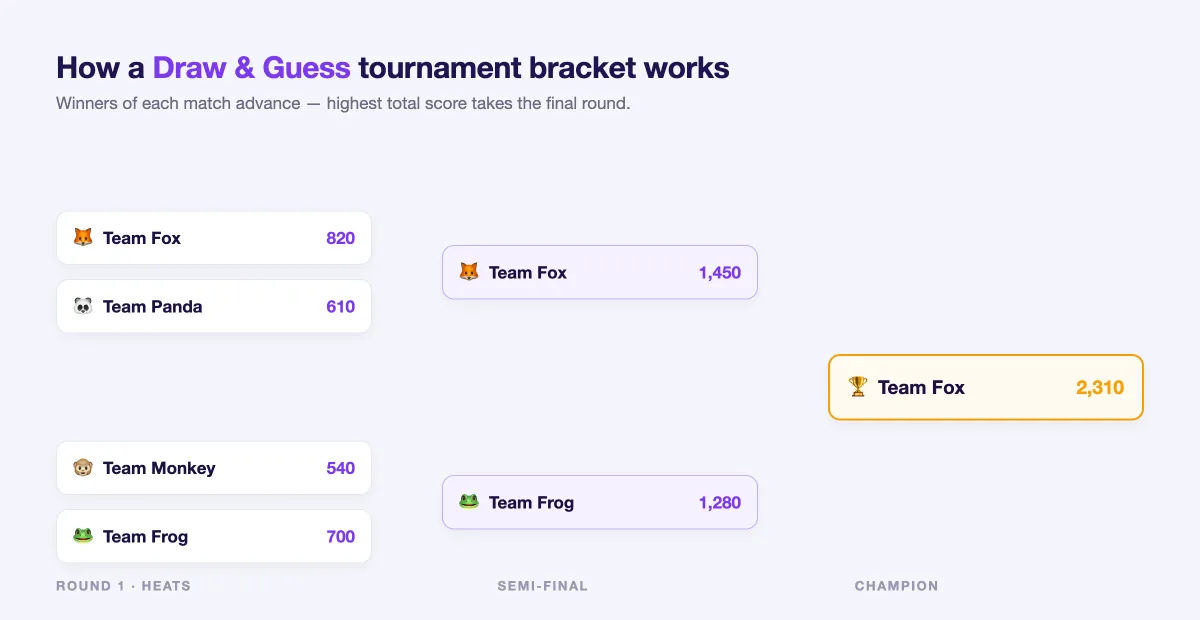
- Round 1 — Heats. Every team plays a round of Draw & Guess. The two highest-scoring teams advance.
- Semi-final. The advancing teams play a tougher word list, and scores stack on top of their heat totals.
- Final. One last round decides it. The team with the highest running total is crowned champion.
Because EngageSlide keeps a cumulative leaderboard, you do not need a spreadsheet or a whiteboard to track any of this — the running totals are always on screen. Here is how a four-team bracket looks as it resolves:
How scoring keeps every round competitive
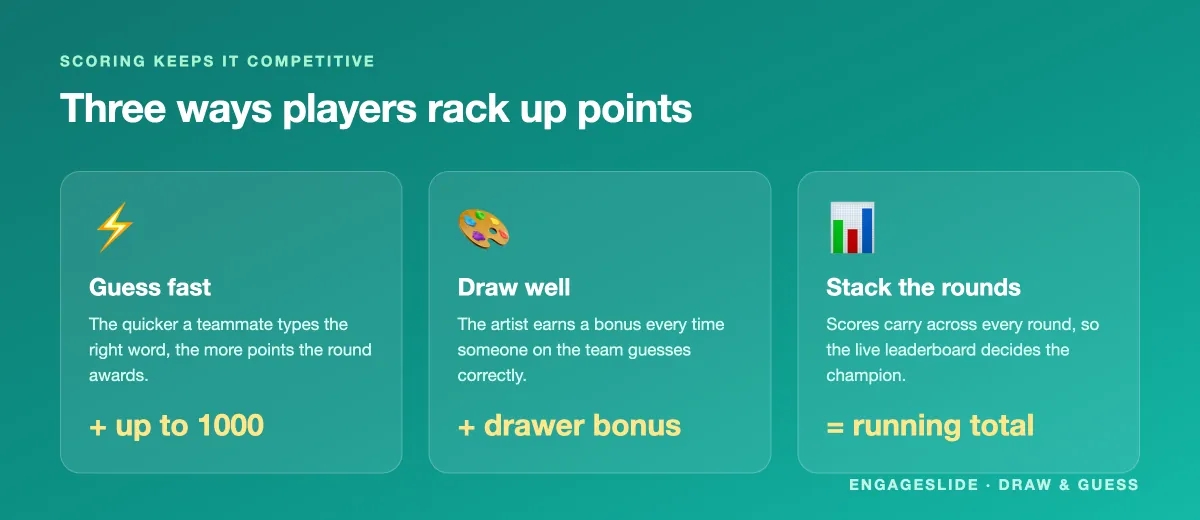
The magic of a tournament is that the leaderboard never sits still. In Draw & Guess, points come from three places, which keeps both the artists and the guessers engaged:
- Speed of the guess. The faster a teammate types the correct word, the more points the round awards — so a late scramble can still flip the standings.
- The drawer's bonus. The person sketching earns points every time a teammate guesses right, rewarding clear, clever drawing over showing off.
- Cumulative totals. Scores carry across every round, so the champion is whoever performed best over the whole tournament, not just the last game.
That blend matters at a company event, where you want the outcome to feel earned but not brutal. A team that stumbles in the first heat can claw back with a fast semi-final. Nobody is mathematically eliminated until the very end, so the room stays loud the whole way through.
Run-of-show: a 25-minute tournament
You do not need a long slot. A tight, well-paced tournament fits neatly into a break in the agenda:
- Minutes 0–3 — Join. Put the QR code on the big screen. People scan, pick a team, and land in a lobby. No app install, no accounts.
- Minutes 3–5 — Explain. One sentence of rules: "Your team takes turns drawing; everyone else guesses; fastest correct answers score most." That is genuinely all people need.
- Minutes 5–15 — Heats. Each team plays a round. Keep word lists light and workplace-friendly.
- Minutes 15–22 — Semi-final and final. The top teams battle on. Read the leaderboard aloud between rounds to crank up the drama.
- Minutes 22–25 — Crown the champion. Reveal the winner on the leaderboard, hand out a small prize, and take a group photo of the winning team's ridiculous drawings.
Presenting from the front of the room? You can drive the whole thing from your phone with EngageSlide's remote control, so you are free to walk the floor and hype up the crowd instead of standing behind a laptop.
Tips that make it land
A few small choices separate a tournament people remember from one that fizzles:
- Curate the word list. Mix easy warm-ups ("coffee", "meeting") with a few inside jokes about your company or product. In-jokes get the biggest laughs.
- Keep rounds short. A 60–75 second drawing timer keeps the pace brisk and stops any single round from dragging.
- Narrate the leaderboard. Between rounds, call out who is up and by how much. That commentary is what turns a game into an event.
- Play to the room, not the artists. Reassure people that bad drawing is the point — the worse the sketch, the funnier the guesses.
Draw & Guess is one of the most reliable ways to add gamification to a presentation, and the tournament format is what turns a quick icebreaker into the highlight of the day. If your teams are fully remote, the same bracket works over a video call — see virtual Pictionary for remote teams for the distributed setup. Prefer to weigh a drawing game against a knowledge quiz for your group? Team quiz vs individual quiz breaks down which competition format fits which crowd.
Draw & Guess borrows its DNA from Pictionary, and its real value at work is the same as any good team-building activity: it gets people talking, laughing, and seeing colleagues as humans rather than calendar invites. Build the bracket once, and you have a repeatable, crowd-pleasing tournament for every company event on the calendar. Browse more interactive ideas on the EngageSlide blog.