
You want to get a room buzzing — a team offsite, a classroom, a Friday social, a conference break. Two live games do this brilliantly, and people always ask which one to run: a Draw & Guess game where one person sketches a secret word while everyone races to guess it, or a Trivia quiz where players answer questions against the clock. They feel similar from the outside — teams, a live leaderboard, lots of shouting — but they pull different levers, and picking the right one (or running both) makes the difference between a good session and a great one.
This guide compares Draw & Guess and Trivia head-to-head so you can match the game to your group, using EngageSlide's interactive presentation tool where both run from the audience's own phones with a QR code — no app, no accounts. If you already know you want one of them, the Draw & Guess setup walkthrough and the guide to building a trivia game for company events cover the how-to; here we focus on the which.
The core difference in one line
Draw & Guess rewards creativity and quick thinking; Trivia rewards knowledge and recall. That single distinction drives almost every other decision. If your goal is to loosen people up, spark laughter, and help a group bond, drawing wins. If your goal is to test what people learned, reinforce facts, or crown the sharpest mind in the room, trivia wins.
Ask yourself one question: do I want the room to relax or to prove what they know? The honest answer usually picks the game for you.
Side by side: how they compare
Here's how the two games stack up across the things that actually matter when you're planning a session:
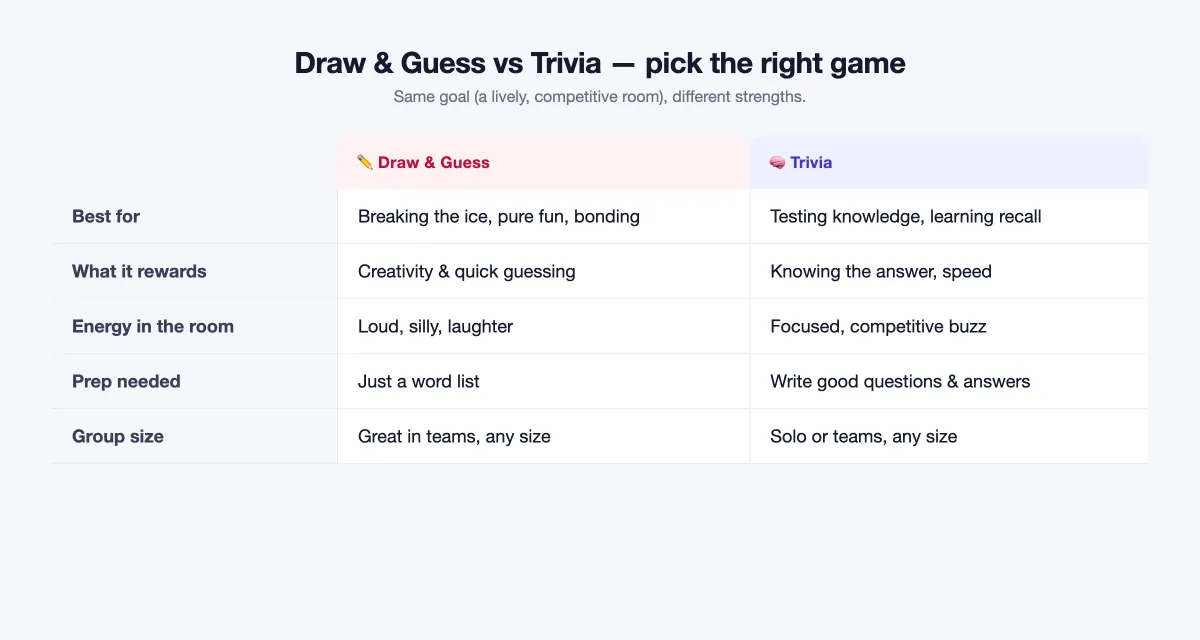
A few of these deserve a closer look, because they're the ones people underestimate.
Energy and mood
Draw & Guess produces a specific kind of chaos: half-finished sketches, wild wrong guesses, and genuine belly laughs. It's disarming — nobody feels judged for a terrible drawing, because bad drawings are the whole point. That makes it ideal early in an event, when people don't know each other yet. Trivia is more focused. The energy is competitive rather than silly, which is perfect once the group is warmed up and ready to go head-to-head.
Prep time
This is the most practical difference. Draw & Guess needs almost nothing — a list of words, which you can brainstorm in two minutes (mix everyday words with a few inside jokes about your team). Trivia needs real preparation: you have to write clear questions with unambiguous correct answers, and bad questions (too obscure, or with arguable answers) can derail the whole game. If you're short on time, drawing is the safer bet. If you can invest 20–30 minutes writing questions — or use EngageSlide's AI to generate a quiz from a topic or a document — trivia gives you a sharper, more purposeful game.
What you're really measuring
Trivia doubles as a learning tool. In a classroom or a training session, a well-built quiz reinforces the material and shows you (and the learners) what stuck — the same reason quizzes work so well to run as teams or individuals depending on your goal. Draw & Guess doesn't measure knowledge at all; its payoff is social. Both are forms of gamification, but one gamifies learning and the other gamifies connection.
Which one fits your group?
Use these quick rules of thumb:
- New team or icebreaker → Draw & Guess. Nothing breaks the ice faster than watching your manager fail to draw a "pineapple."
- Classroom or training review → Trivia. You get engagement and a knowledge check in one activity.
- Big mixed crowd at an event → Draw & Guess, in teams. It scales to any size and needs zero background knowledge, so nobody is left out.
- Product launch or onboarding → Trivia about your product. It's fun and it drills the key facts you want people to remember.
- Low prep time → Draw & Guess. A word list beats writing twenty solid questions when the clock is ticking.
- You want a clear "smartest in the room" winner → Trivia. Knowledge-based scoring feels the most decisively earned.
For fully remote teams, both translate well to a video call — see virtual Pictionary for remote teams for the distributed drawing setup, and note that a Draw & Guess tournament scales the drawing game into a bracket when you have a longer slot to fill.
The best answer is often "both"
You don't actually have to choose. The strongest sessions use the two games in sequence, because they complement each other perfectly: the drawing game warms the room up and dissolves social awkwardness, and once everyone is laughing and comfortable, trivia gives that energy a competitive target.
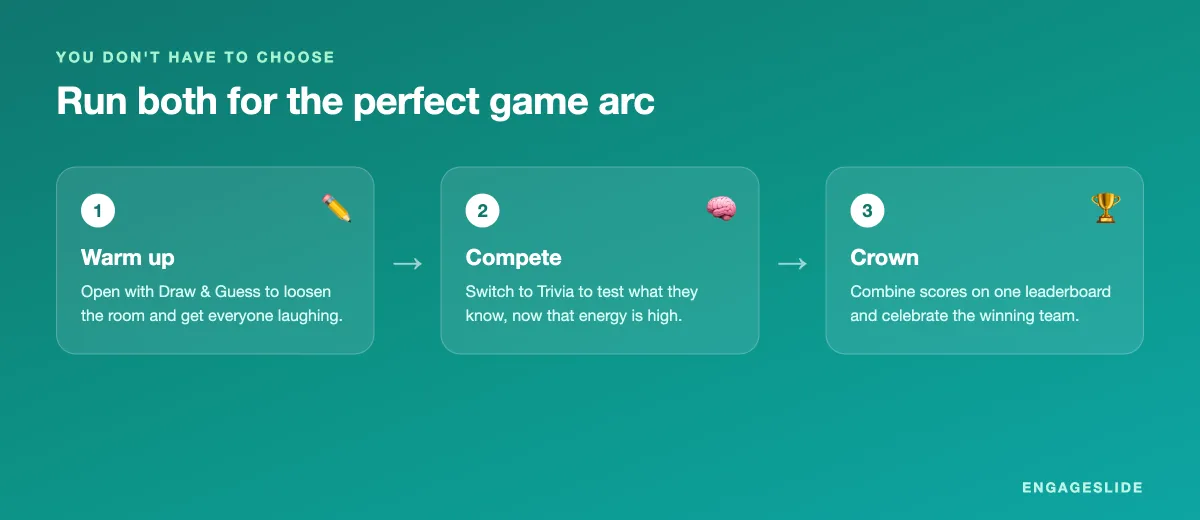
Because both games live inside the same EngageSlide presentation, running them back to back is effortless — you add a Draw & Guess slide, then a quiz slide, and the audience uses the same join link for both. Keep a single leaderboard across the two and you get a satisfying arc: silly warm-up, focused competition, one champion at the end. It's the same "learning loop" logic that makes interactive sessions stick — start with low stakes, build to a payoff.
Getting started
Whichever you pick, the setup is the same three moves in EngageSlide: add the slide type you want, put the join QR code on screen, and let people join from their phones. For Draw & Guess, drop in a word list and hit start. For Trivia, write a handful of questions (or generate them with AI) and set a timer per question. Test your word list or questions on one colleague first — it's the fastest way to catch a word nobody can draw or a question with a fuzzy answer.
Both games draw on classics — Draw & Guess is live Pictionary, and Trivia is the same format as a good pub quiz — and both work because a live leaderboard turns a passive audience into players. Match the game to your goal, or run them in sequence, and you'll get the room you're hoping for. Browse more interactive session ideas on the EngageSlide blog.