
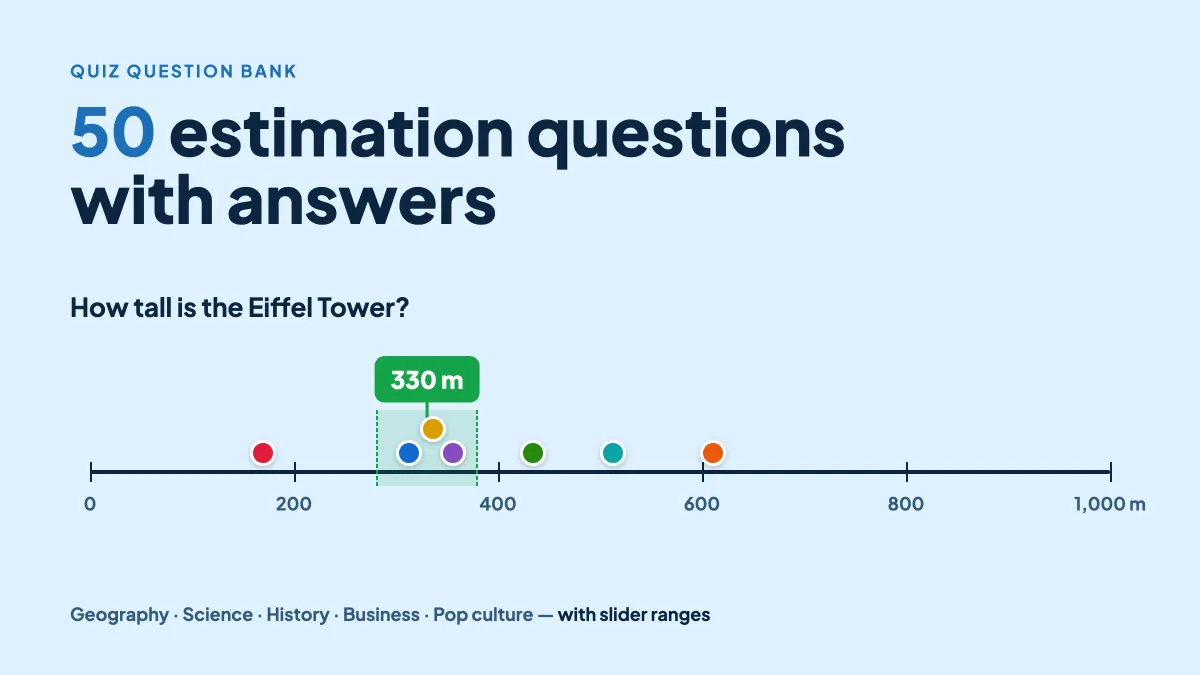
Estimation questions are the friendliest quiz format there is. Nobody needs to know the exact answer, everyone can make a guess, and the moment the real number appears always gets a reaction. The hard part is coming up with good questions and sensible ranges on a busy day. So here are 50 estimation questions with answers, grouped by theme, each with a suggested slider range and unit. Copy them straight into an Estimate slide in EngageSlide, or use them on paper. Every answer is a well-documented number that will not change next month.
How to use this list
Each question comes with three things: the answer, the unit and a slider range. In EngageSlide's Estimate slide, players drag a slider (or type a number) to lock in a guess, and the closer the guess, the more points. You type the correct answer, the unit and the Min, Max and Step of the slider. If you have not set one up before, our guide to estimation questions walks through the whole slide; this post is the question bank.
Three rules behind the ranges below:
- The answer is never in the middle. If the slider runs from 0 to 600 and the answer is 300, the safest guess wins. Put the answer off-centre.
- The range is believable. A range from 0 to 1,000,000 metres for the Eiffel Tower gives the answer away by being silly. Choose limits a reasonable person might guess.
- Huge ranges use a logarithmic slider. For numbers like the speed of light, switch the slider to Logarithmic so small and large values both get room.
Geography (10 questions)
- How tall is the Eiffel Tower? 330 m · slider 0–1,000 m
- How high is Mount Everest? 8,849 m · slider 0–15,000 m
- How long is the Nile? About 6,650 km · slider 0–10,000 km
- How many countries are members of the United Nations? 193 · slider 0–300
- How wide is the Strait of Dover at its narrowest? About 33 km · slider 0–100 km
- How long is the Panama Canal? About 82 km · slider 0–200 km
- How many time zones does Russia span? 11 · slider 0–30
- How tall is the Burj Khalifa? 828 m · slider 0–2,000 m
- How far is it from London to New York in a straight line? About 5,570 km · slider 0–15,000 km
- How deep is Lake Baikal at its deepest point? 1,642 m · slider 0–5,000 m
Science (10 questions)
- How many bones are in the adult human body? 206 · slider 0–500
- How fast does light travel? About 299,792 km per second · slider 1–1,000,000 km/s, logarithmic
- At what temperature does water boil at sea level, in Fahrenheit? 212 °F · slider 0–500 °F
- How far away is the Moon on average? About 384,400 km · slider 0–1,000,000 km
- How many elements are in the periodic table? 118 · slider 0–200
- What is the diameter of the Earth? About 12,742 km · slider 0–30,000 km
- How many teeth does an adult usually have? 32 · slider 0–100
- How hot is the surface of the Sun? About 5,500 °C · slider 0–20,000 °C
- How fast does sound travel through air at 20 °C? About 343 m/s · slider 0–1,000 m/s
- How long does sunlight take to reach the Earth? About 8.3 minutes · slider 0–30 minutes, step 0.1
History (10 questions)
- In what year did people first walk on the Moon? 1969 · slider 1900–2000
- In what year did the Berlin Wall fall? 1989 · slider 1950–2010
- In what year did the Titanic sink? 1912 · slider 1880–1960
- In what year were the first modern Olympic Games held? 1896 · slider 1800–1950
- In what year was Magna Carta sealed? 1215 · slider 1000–1600
- How tall was the Great Pyramid of Giza when it was built? About 146 m · slider 0–400 m
- How many people have walked on the Moon? 12 · slider 0–50
- How many years did the Hundred Years' War last? 116 · slider 50–200
- How old was Mozart when he died? 35 · slider 0–100
- In what year did the first iPhone go on sale? 2007 · slider 1980–2020
Business and technology (10 questions)
- In what year was Google founded? 1998 · slider 1970–2015
- In what year was Amazon founded? 1994 · slider 1970–2010
- In what year was Microsoft founded? 1975 · slider 1960–2000
- In what year was the first email sent between two computers? 1971 · slider 1950–2000
- In what year was the first text message (SMS) sent? 1992 · slider 1960–2010
- In what year did Wikipedia launch? 2001 · slider 1980–2015
- In what year was YouTube founded? 2005 · slider 1990–2015
- In what year was a product barcode first scanned in a shop? 1974 · slider 1930–2000
- How many characters could the original tweet have? 140 · slider 0–500
- How many hours are in a (non-leap) year? 8,760 · slider 0–20,000
Pop culture, sport and games (10 questions)
- How many keys does a standard piano have? 88 · slider 0–200
- How long is a marathon? 42.195 km · slider 0–100 km, step 0.1
- How many squares are on a chessboard? 64 · slider 0–200
- How many dots are on a standard six-sided die in total? 21 · slider 0–50
- How high is a basketball hoop? 3.05 m · slider 0–10 m, step 0.01
- How many cards are in a deck without the jokers? 52 · slider 0–150
- How long is a tennis court? 23.77 m · slider 0–60 m, step 0.01
- In what year was the first Star Wars film released? 1977 · slider 1940–2000
- In what year was the LEGO company founded? 1932 · slider 1900–1990
- How many minutes are in a day? 1,440 · slider 0–5,000
Running the questions in EngageSlide
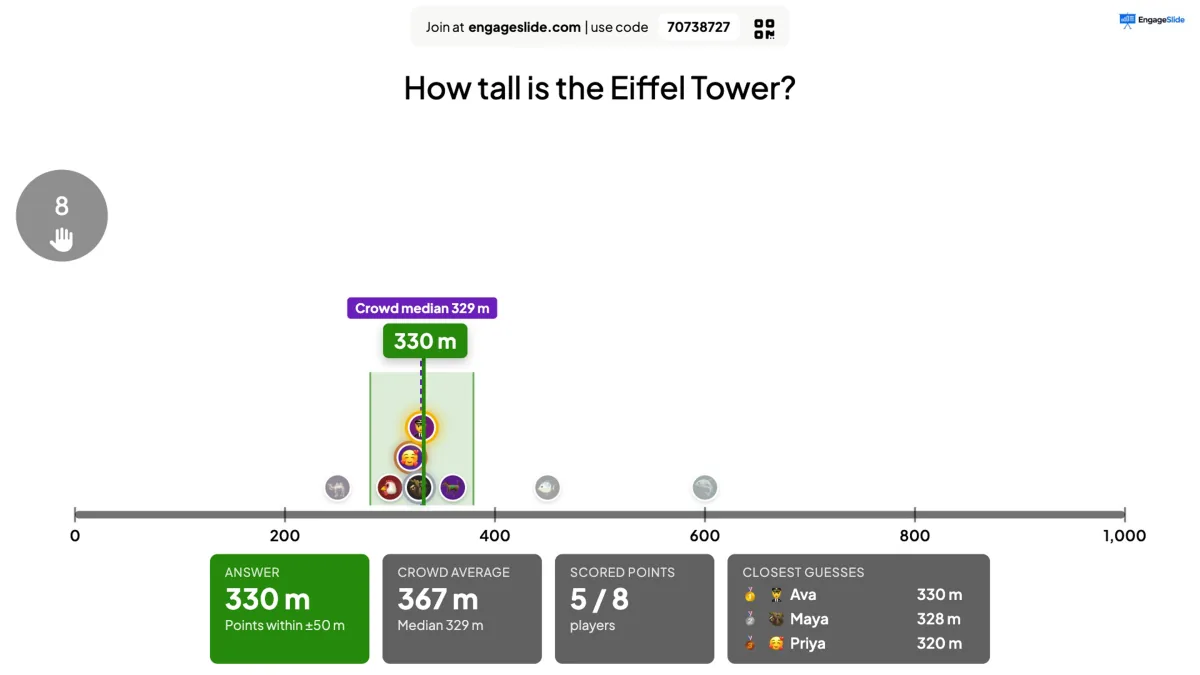
Add one Estimate slide per question. Type the question, enter the answer and unit, and copy the slider range from the list. Then choose Who scores points: Exact, ±2%, ±5%, ±10% or Everyone. The percentage is of the slider range, not of the answer, so on a 0–1,000 m slider ±5% means guesses within 50 m score. The slide shows the exact scoring band as you change it.
Some practical choices that work well with this list:
- Years: use ±2%. On a 100-year slider that is two years either side, which rewards people who really know.
- Big physical numbers: use ±10% or Everyone. Nobody knows the Moon's distance to the kilometre; reward the people who are in the right area.
- Give 30 to 60 seconds. Estimating is thinking, not tapping. Sixty seconds is the default.
- Add a picture. A photo of the Burj Khalifa or a piano keyboard makes the question clearer and more fun. The image appears large on the big screen and on every phone.
- Finish on a Leaderboard. Estimate is a scored quiz question, so the points add up on a Leaderboard slide like any other quiz.
Talk about the crowd, not just the winner
At the reveal, every guess drops onto a number line, the crowd median is marked and the three closest guesses get medals. The median is often the most interesting number on screen. Ask the room: was the group closer than most individuals? Often it is, an effect known as the wisdom of the crowd. And when the group is far off, ask why so many people guessed in the same wrong direction.
The best estimation question is one where the room is confident and wrong. The surprise is what makes the number stick.
For classes, estimation is a skill worth practising in its own right. Ask students how they got to their guess before you reveal the answer: breaking a big question into smaller ones you can reason about is the idea behind Fermi problems, and it works for maths, science and geography.
Write your own estimation questions
- Use a fact with one clear number. "How long is the Great Wall of China?" has several competing answers depending on what you count. Pick facts with one accepted value, or say "about".
- Make it about your audience. "How many support tickets did we close last quarter?" or "How many students are in our school?" are great in a meeting or assembly.
- Mix easy and hard. Start with a year most people can get close to, then move to numbers nobody has a feel for.
- Check the answer twice. A wrong answer on a big screen costs more trust than a missing question.
Looking for more formats to mix in? Browse the EngageSlide blog for quiz and game ideas, or open the Estimate slide and build your first round from the list above.