
The first two minutes of a meeting decide how the rest of it goes. If people have already tapped an answer and laughed at the result, they talk. A short round of fact or myth questions is one of the fastest ways to get there. Everyone has an opinion, nobody needs to prepare, and being wrong is half the fun. Below you'll find 25 ready-to-use statements across five themes, each with the answer and a one-line reason, plus how to run them as a live True or False quiz in EngageSlide.
Why fact or myth questions make a great warm-up
Most icebreakers ask people to share something personal. A fact or myth statement asks much less: read one sentence, pick a side. Nobody has to speak, and quieter people still take part.
It also gets people thinking. When someone commits to an answer and then sees the reveal, the correction sticks. That's the testing effect: answering a question beats re-reading. A good myth also starts conversation by itself.
How to run a fact or myth round in EngageSlide
EngageSlide has a dedicated True or False quiz slide for this. Setup:
- Add the slide. In your interactive presentation, add a new slide and choose True or False from the quiz slides.
- Write the statement as the question title. One sentence, like the ones below.
- Pick the answer labels. Under Answer labels, choose Fact / Myth. True / False, Real / Fake and Yes / No are also there if they suit your topic better.
- Mark the right answer. Set the side the statement belongs to.
- Add the "Why?" This short explanation shows at the reveal, so it's where you bust the myth. You can also add an optional source, such as "NASA".
- Set the timer and points. Answers feed the leaderboard and the session report.
When you present, the statement appears with two big sides. People join by code or QR and tap a side. When time is up, the screen shows how the room split, with avatars on each side, then stamps the verdict and shows the Why card and the fastest correct answer.
If you want the full picture of the slide type, including when to use each label set, read our guide to the True or False quiz game.
25 fact or myth statements, with answers
Each has a clear, defensible answer. Paste the reason into the Why field.
Science
- "Lightning never strikes the same place twice." Myth. Tall structures get hit again and again. The Empire State Building is struck around 20 times a year (National Weather Service).
- "Humans only use 10% of their brains." Myth. Brain scans show activity in nearly every region, even during sleep.
- "Sound travels faster through water than through air." Fact. It moves about four times faster in water, around 1,480 m/s compared with 343 m/s in air.
- "You can see the Great Wall of China from the Moon with the naked eye." Myth. The wall is far too narrow, and astronauts say it's hard to spot even from low orbit.
- "Venus is the hottest planet in our solar system." Fact. Mercury is closer to the Sun, but Venus's thick carbon dioxide atmosphere traps heat, so it's hotter.
History
- "Napoleon was unusually short." Myth. He was about 1.69 m (5 ft 7 in), average for a Frenchman of his time. Old French inches made him sound shorter.
- "Vikings wore horned helmets into battle." Myth. There's no evidence they did. The horns came from 19th-century costume design, especially for Wagner's operas.
- "Cleopatra lived closer in time to the Moon landing than to the building of the Great Pyramid." Fact. The pyramid was built around 2560 BC. Cleopatra died in 30 BC, about 2,000 years before 1969.
- "Oxford University is older than the Aztec Empire." Fact. Teaching at Oxford dates back to 1096, while Tenochtitlan was founded in 1325.
- "Einstein failed maths at school." Myth. He was excellent at maths and had taught himself calculus by about age 15.
Work and technology
- "Email was invented after the World Wide Web." Myth. Ray Tomlinson sent the first network email in 1971, nearly 20 years before the web.
- "Multitasking makes you more productive." Myth. Every switch between tasks costs time and focus, so doing two things at once usually means doing both more slowly.
- "A real moth was once logged as a computer 'bug'." Fact. In 1947, engineers working on the Harvard Mark II taped a moth into their logbook as the "first actual case of bug being found".
- "The five-day work week has always been the norm." Myth. It spread in the 20th century, helped along when Ford adopted a five-day, 40-hour week for factory workers in 1926.
- "The word 'deadline' first meant a line prisoners couldn't cross." Fact. In the American Civil War, it was a boundary in prison camps that guards would shoot anyone for crossing.
Food
- "Properly sealed honey can stay edible for thousands of years." Fact. It has very little water and is acidic, so bacteria can't grow in it. Archaeologists have found preserved honey in ancient Egyptian tombs.
- "Eating lots of carrots gives you night vision." Myth. Vitamin A supports normal eyesight, but extra carrots don't improve it. The story was spread in WWII to hide the use of radar.
- "Bananas are berries, but strawberries aren't." Fact. Botanically speaking, a banana counts as a berry and a strawberry doesn't.
- "You must wait 30 minutes after eating before you swim." Myth. There's no evidence that swimming on a full stomach raises the risk of drowning.
- "Peanuts aren't nuts." Fact. They're legumes and grow underground, like beans and peas.
Animals
- "Goldfish have a three-second memory." Myth. Goldfish remember things for months and can be trained to respond to sounds, colours and feeding times.
- "Bats are blind." Myth. Every bat species can see, and many also use echolocation.
- "An octopus has three hearts." Fact. Two pump blood through the gills and one pumps it around the rest of the body.
- "Ostriches bury their heads in the sand when scared." Myth. They lower their heads to turn the eggs in their ground nests, which from a distance looks like burying.
- "Bulls get angry when they see the colour red." Myth. Bulls can't really tell red from other colours. They react to the movement of the cape.
What your audience sees on their phones
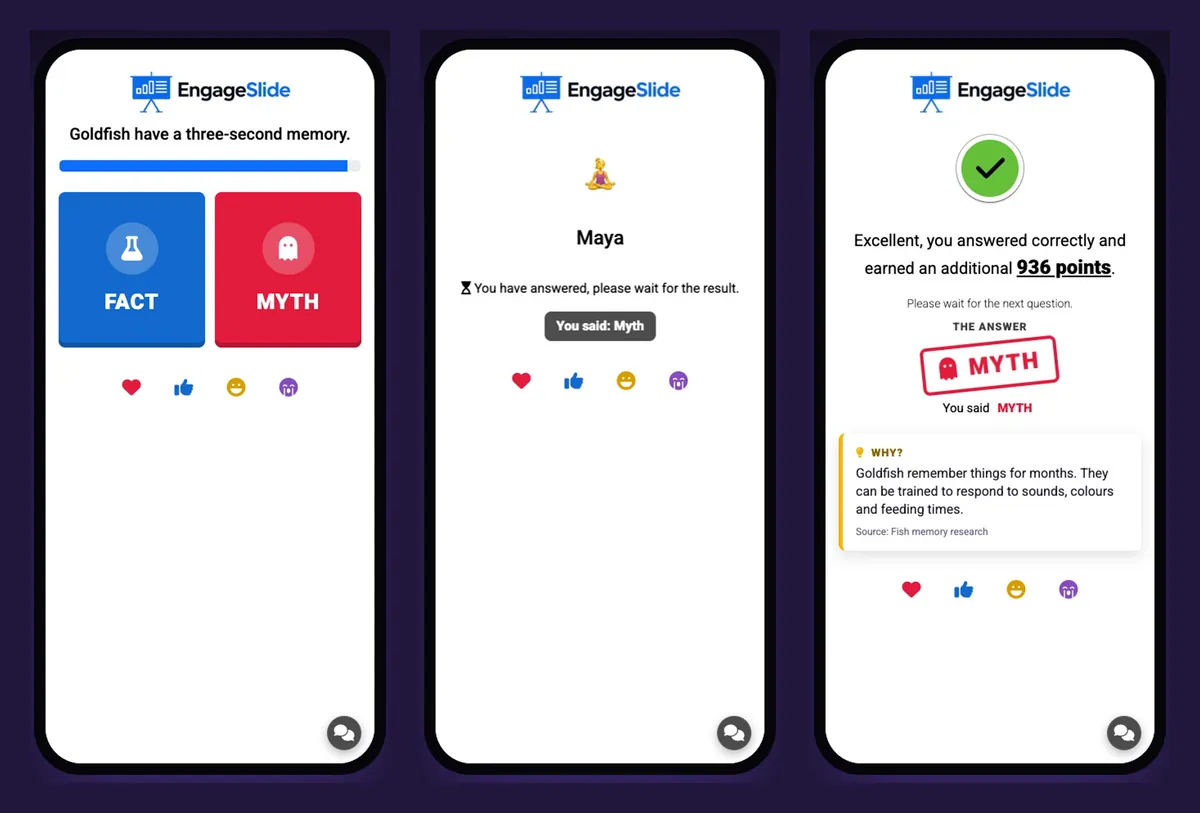
On a phone, each player sees the statement and two large buttons, one tap, done. Their answer is locked in with a "You said: Myth" confirmation while everyone else decides. After the reveal, each phone shows whether the player was right, the points they earned, the stamped answer and the same Why explanation. Remote attendees on a small laptop still get the reason.
How to pick five statements for one meeting
You don't need all 25. Five statements take about five minutes. A few guidelines:
- Mix the answers. Aim for roughly three myths and two facts. If every answer is "Myth", people stop thinking and just tap Myth.
- Open with a confident myth. Goldfish or lightning work well because most of the room gets them wrong.
- Close with a surprising fact. The Cleopatra and Oxford statements usually get a "no way!", which is a good mood to start the agenda in.
- Match the theme to the room. Use the work statements for a team meeting, food for a Friday social, and science or history for a class or workshop.
- Keep the timer short. Ten to fifteen seconds is enough for one sentence.
The best warm-up isn't the one with the hardest question. It's the one where everyone answers, most people are surprised, and the reveal gets people talking.
Tips for a smoother reveal
- Pause on the split. Before you read the Why card, say "Most of you said Fact..." and let the room react. That moment is the whole point of the game.
- Add a source when people will check. For a sceptical group, the optional source line saves you a debate.
- Use the leaderboard lightly. Points and speed are scored automatically; for a warm-up, show the leaderboard once at the end.
- Write your own. Once your team knows the format, invite people to send in a fact or myth about your product, your industry or the office. For an onboarding version, see our myth-busting onboarding quiz.
Where to go next
For more formats, such as picture reveals, match-up rounds and team play, browse our list of live quiz ideas, or explore more guides on the EngageSlide blog. Pick five statements, add them as True or False slides, and your next meeting starts with the whole room talking.