
A coin toss is the oldest way to settle a question fairly. It takes one second, nobody can argue with it, and everyone understands it. EngageSlide turns it into a game your whole room plays at once. With the Heads or Tails slide, everyone calls the coin on their phone, a big gold coin spins on the screen, and everyone who called it wrong is out. Flip after flip the room halves, until only your winners are left — one, or several if you are giving away more than one prize.
Below you'll find how the game works, what makes each flip exciting, the two settings, and practical ways to use it for prize draws, classrooms and events.
How Heads or Tails works
Add a Heads or Tails slide from the Games tab, present it and let people join with your code or by scanning the QR code. There is nothing to prepare. When everyone is in, press START, and each flip runs like this:
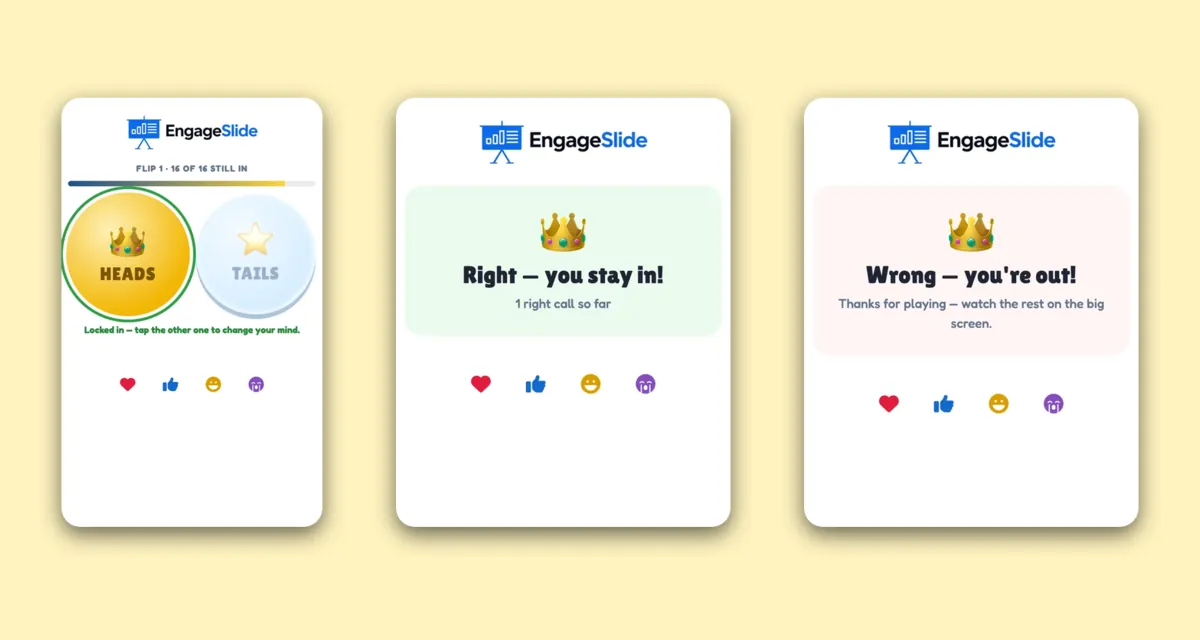
- Call. Phones show two big coins to tap: HEADS 👑 and TAILS ⭐. The chosen coin gets a green ring, and players can switch until the coin flips.
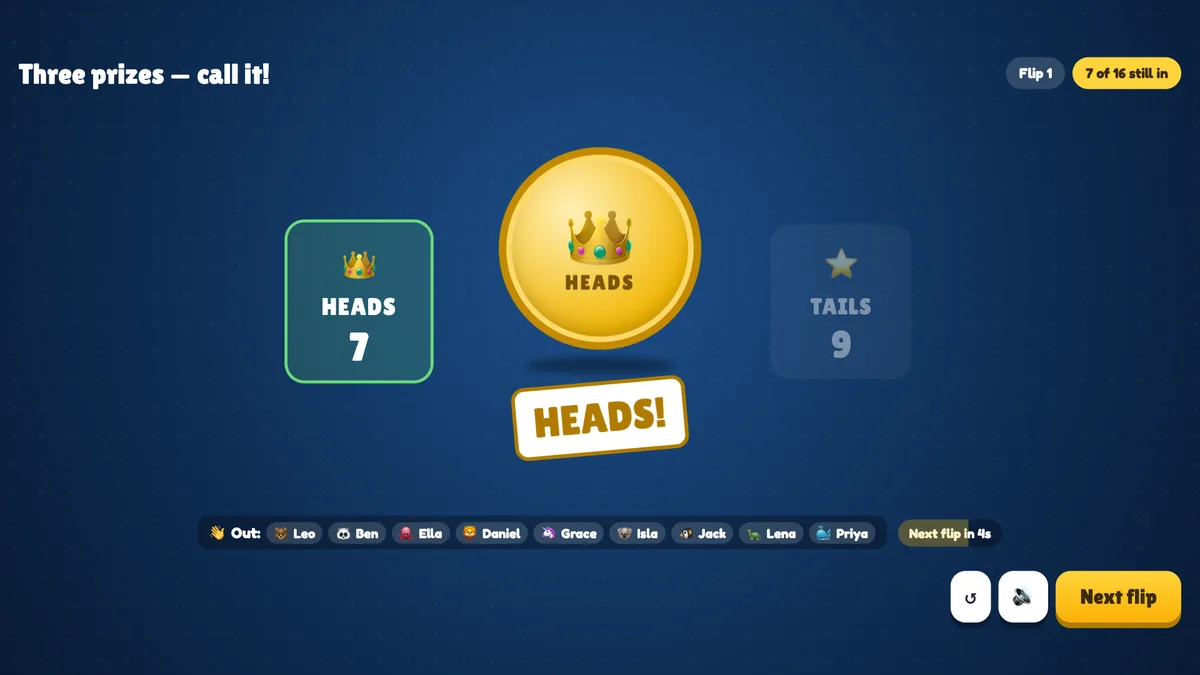
- Watch the split. On the big screen, a panel on each side counts the calls live — for example HEADS 5 · TAILS 7. The room can see which side is crowded before the coin goes up.
- Flip. The coin spins for about two seconds and lands with a stamp: HEADS! or TAILS! The winning side lights up and everyone who called it wrong — or didn't call — is listed under Out:.
The next flip starts by itself after a few seconds, or press Next flip. When your winners are left, press See results: the winners get crowns, and everyone else is listed with the flip they went out on.
Why each flip feels big
A real coin flip is over before anyone feels anything. On the big screen, three things stretch that moment out. First, the live split: if 30 people called heads and 8 called tails, everyone knows a tails landing would wipe out most of the room. Second, the spin: two seconds of a turning coin is long enough to hold your breath. Third, the stamp: the landing is loud and final, and the Out list appears instantly. The result is a genuine cheer-or-groan moment, flip after flip.
Nobody loses everyone
If every player still in calls it wrong, nobody goes out and the coin is flipped again. The game can never end with zero winners.
Choose how many winners
The setting that makes Heads or Tails different from other elimination games is Play until. You choose how many players should be left at the end: 1 winner (default), or 2, 3, 5 or 10 winners. The game stops as soon as that many players — or fewer, if a flip knocks out more than needed — are left.
That makes it a natural fit for giveaways with several prizes. Running a draw for three books? Set Play until to 3. Instead of three names popping out of a hat, fifty people get six or seven flips of real suspense, and the three winners are decided in front of everyone.
The other setting is the time to call: 5, 8 (default) or 10 seconds per flip. The coin flips early once everyone still in has called, so a fast room never waits for the timer.
What players see on their phones
- Before the game: You're in! and the rule in one line.
- During a call: the flip number, how many players are still in, a time bar and the two coins.
- While the coin spins: Flipping… and their own call, so they know what they're hoping for.
- When it lands: Right — you stay in! with their streak, Wrong — you're out!, or — when the whole room was wrong — Wrong — but saved!
- At the end: winners see You are a winner! and everyone else sees their place and how many right calls they made.
Players who are out keep watching the big screen. Anyone who joins after the start watches the current game and plays in the next one when you press Play again.
Setting it up
- Add a Heads or Tails slide from the Games tab.
- Type a title for the big screen — for example Three prizes — call it!
- In Settings, choose the time to call and how many winners to play for.
- Present, let everyone join, and press START (or Enter).
The Help Center has a full walkthrough with every screen: how to use Heads or Tails. For a quick overview, see the Heads or Tails slide page.
A prize draw where everyone plays is a better prize draw. People who don't win still had six flips of fun — and they saw that the result was fair.
Ways to use Heads or Tails
Prize draws and giveaways
This is the use case people love most. A traditional raffle is over in a second and only exciting for the winner. Heads or Tails keeps the whole room involved until the end, and because the coin is chosen at random the moment calling closes, nobody can suspect the host of picking favourites. Set Play until to the number of prizes and let the coin decide.
Closing a session
Need a minute while the next speaker sets up? One game fills it perfectly and keeps people in their seats instead of drifting to their inboxes.
Big events
Everyone in the hall plays at once, and the live split of calls keeps even the players who are out watching. Ask the room before a flip: "Twenty of you are on tails — who's brave enough?"
The classroom
It works as a quick reward at the end of a lesson, and it doubles as a real-life probability lesson. Before you start, ask the class to predict how many flips it will take to go from 30 players to one. Halving each time, the answer should be about five — then play and compare. Afterwards, look at the results list: some players will have called it right four or five times in a row, which is a great starting point for a discussion about luck and streaks.
Picking a volunteer
Play with Play until 1 winner and the last one standing presents first, chooses the next topic or wins the honour of the next task.
If you like this kind of quick, no-preparation game, try Rock Paper Scissors for the whole room, where the last two face each other in a final duel, or the Quick Draw reaction game.
Tips for running it
- Read out the split before every flip. It builds tension and gets people talking.
- Use the 8-second default for in-person groups and 10 seconds for remote audiences.
- Announce the prize first. Knowing what's at stake makes every call matter.
- Don't worry about stragglers. No call counts as wrong, so the game never waits for someone who walked away.
Frequently asked questions
Is the coin really random?
Yes. The side is chosen at random at the moment calling closes. Nobody, including the host, knows it in advance.
Why did the game end with fewer winners than I chose?
One flip can knock out more players than needed. If four are left, you play for three and two of them call it wrong, the game ends with two winners. It never continues until everyone is out.
Can I play alone to test it?
Yes. Alone, you keep calling until you get one wrong — a fun way to see how long your streak lasts.
Does it change quiz scores?
No. Heads or Tails has its own results and does not touch your quiz leaderboard.
Heads or Tails is part of EngageSlide's interactive presentation tool, next to quizzes, polls, word clouds and live Q&A. Add it to the end of your next deck and turn the prize draw into the best minute of the session.
Cover photo: Ivan Radic, via Wikimedia Commons, licensed CC BY 2.0.