
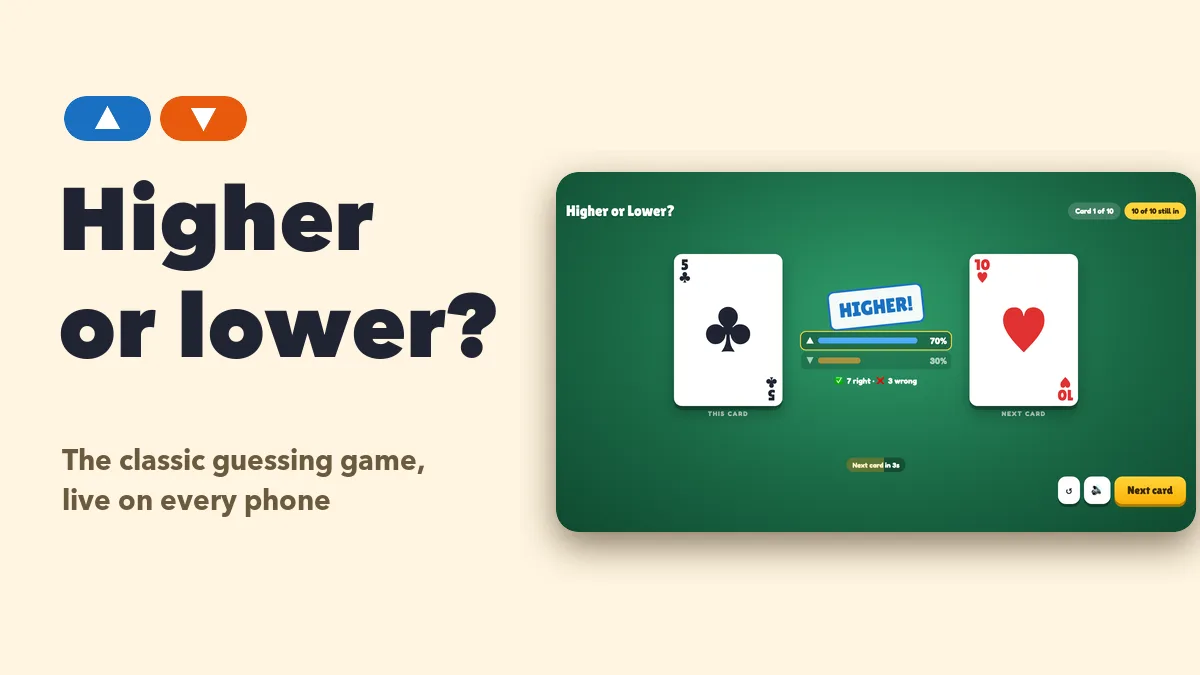
Some games never get old. Higher or Lower has filled TV schedules for decades — the American show Card Sharks and its British cousin Play Your Cards Right were built on it — because anyone understands it in one sentence: a card is showing, will the next one be higher or lower? Now your whole room can play it at once. In EngageSlide, the card sits on the big screen, everyone guesses on their phone, the next card flips, and wrong guesses cost a life until only the sharpest players are left.
This guide covers how the game works, the three kinds of deck (including your own list, which turns it into a quiz about any topic), the settings, and ideas for classrooms, training and events.
How Higher or Lower works
Add a Higher or Lower slide from the Games tab, present it and let people join with your code or QR code — no app needed. Each card goes like this:
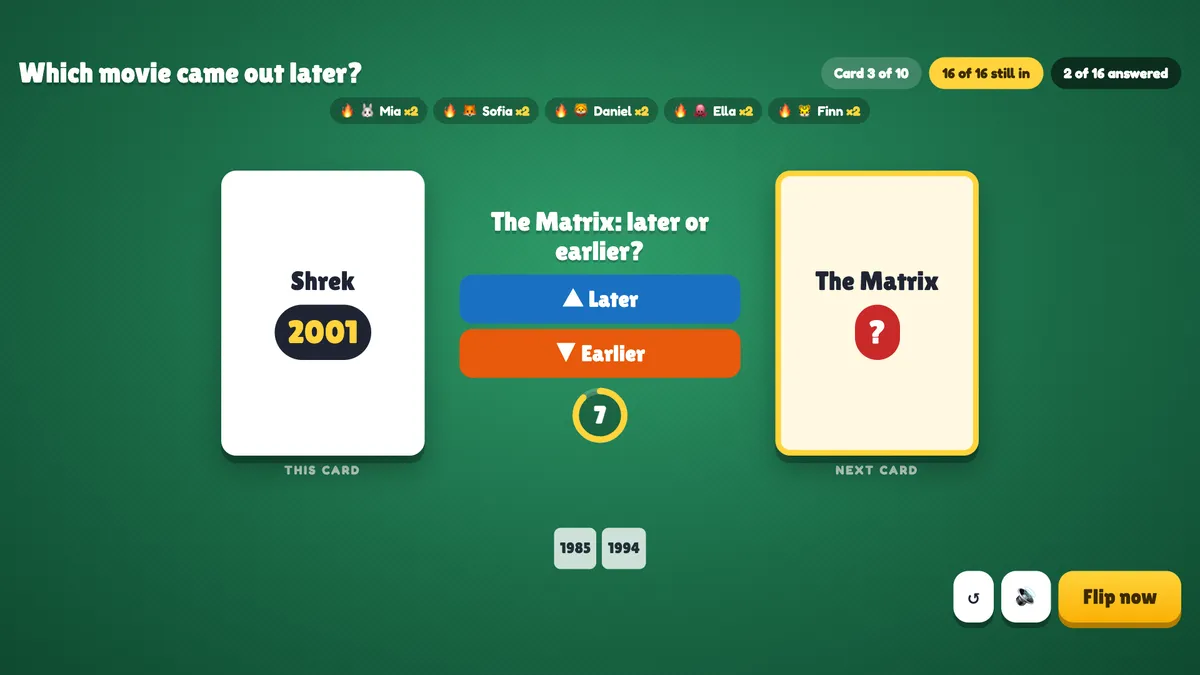
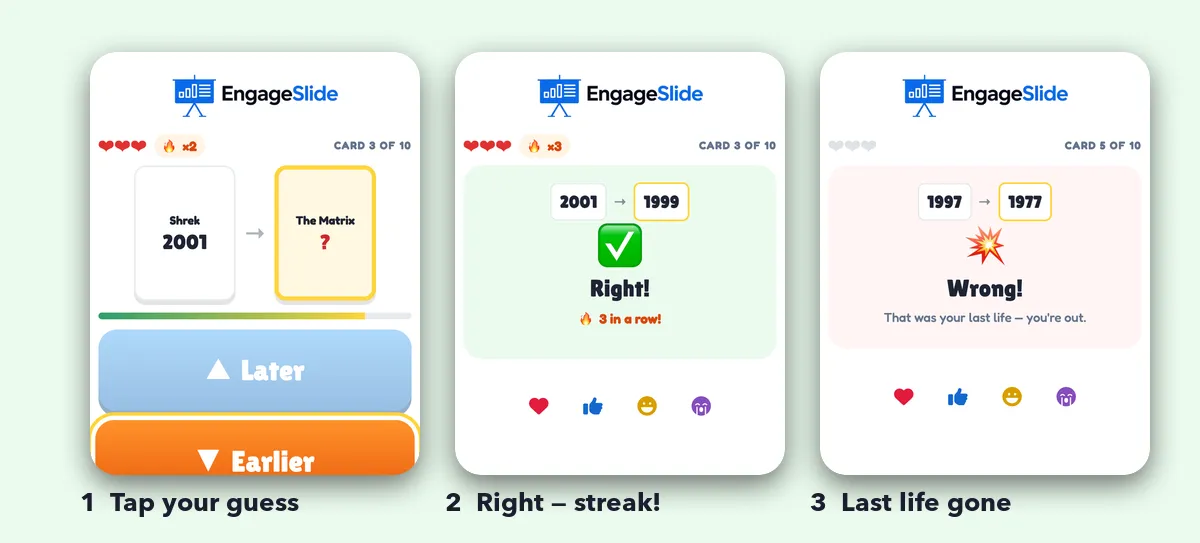
- Guess. The current card is on the left of the big screen and the next card waits face-down on the right. Phones show two big buttons, ▲ Higher and ▼ Lower, and a timer. Players can change their mind until the card flips.
- Flip. The next card turns over, a stamp says HIGHER!, LOWER! or SAME!, and bars show how the room split.
- Consequences. Right guesses grow a 🔥 streak. Wrong guesses — and no guess at all — cost a life. Players with no lives left are listed under Out and watch the rest of the game.
The next card comes by itself after a few seconds, and the game ends when the cards run out, when only one player is left standing or when everyone is out. The final standings rank the survivors first, then everyone else by how long they lasted, right guesses and best streak.
Three decks to play with
Numbers 1 to 100
The default and the fastest to start: random numbers, never the same one twice in a row. It is pure instinct — after a 92 everyone says lower, after a 50 the room splits down the middle. No setup at all.
Playing cards
A shuffled 52-card deck with the ace high and the two lowest. Ties — say, a 7 after a 7 — are safe for everyone. It looks great on a big screen and gives maths teachers an easy way into probability: why is “higher” the smart call after a 3?
Your own list
This is where Higher or Lower becomes a learning game. Make a list of things that each have a number — release years, heights, prices, populations, distances, scores — and the game asks questions like “The Matrix: later or earlier than Shrek?”. You can rename the buttons to fit (Later / Earlier, Taller / Shorter) and add a unit such as m or km/h. Two templates are built in — Which movie came out later? and Which one is taller? — and you can paste your own list as Name | number lines, up to 40 items. The list is shuffled every game.
Rules that keep it fair and fun
- Ties are safe. If the next card has the same value, everyone is right.
- Change your mind freely. A guess is locked in only when the card flips — the phone says Locked in — tap the other one to change your mind.
- No mass knockouts. If every player still in gets a card wrong, nobody loses a life on that card, so a game can’t end all at once on one surprise.
- Late joiners wait one card. Someone who joins mid-card plays from the next one, with full lives.
- Lives or no elimination. Choose 1, 2 or 3 lives, or ♾ — everyone plays every card and the most right guesses wins. No elimination is kinder for classrooms; three lives is the sweet spot for events.
The magic of Higher or Lower is that the rules take five seconds to explain, but every flip creates a moment — a groan, a cheer, a “no way that’s older!” — that people remember.
How to set it up
- Add the slide from the Games tab.
- Pick a deck: Numbers, Playing cards or Your own list. Choosing your own list on an empty slide loads the movie template so you can play straight away.
- For your own list, edit the items (a name and a number on each line), set the button words and the unit, or click Paste list.
- Open Settings and choose the number of cards to guess (5, 10, 15 or 20), the time per card (5, 8, 10 or 15 seconds) and the lives.
- Present and press START. Use Flip now if the room has already answered, or let it flip early by itself once everyone still in has guessed.
The Higher or Lower help article walks through every setting with screenshots, and the Higher or Lower slide page shows the game in action.
Ideas for your own lists
Classroom
History dates (Earlier / Later), planet sizes, river lengths, populations of capitals, the value of fractions and decimals. Students learn the order of things by arguing about it, and each flip is a natural moment to add a fact. For a reflective follow-up, pair it with a True or False quiz on the surprising items.
Training and onboarding
Product prices, response-time targets, market sizes, survey results your team should know. Guessing first and seeing the real number second is a much stronger memory hook than a slide of statistics.
Events and socials
Movie years, song releases, famous buildings, sports records — with a prize for the last player standing. Higher or Lower also makes a good closing round after a game like Quick Draw, because it rewards knowledge and nerve rather than reflexes.
Tips for writing a great list
- Use real, checked numbers. Your audience will challenge a surprising flip — be sure you’re right.
- Keep values close enough to be tricky. Ten items spread over a century are easier than ten items from the same decade.
- Add one or two surprises. The building everyone thinks is tall but isn’t is the card people talk about afterwards.
- Use 10–16 items. That gives 9–15 guesses — plenty for a single game.
Frequently asked questions
What happens if nobody answers?
No guess counts as wrong. With lives on, that costs a life — unless every player still in got it wrong, in which case nobody loses one.
Can I play alone to test it?
Yes. With one player, wrong guesses do cost lives, so you can rehearse the whole game before your session.
Does it change quiz scores?
No. Higher or Lower has its own final standings and leaves your quiz leaderboard untouched.
Higher or Lower joins quizzes, polls, word clouds and Q&A in EngageSlide’s interactive presentation tool. Build a list about your topic, put it on the big screen and let the room argue about every flip.