
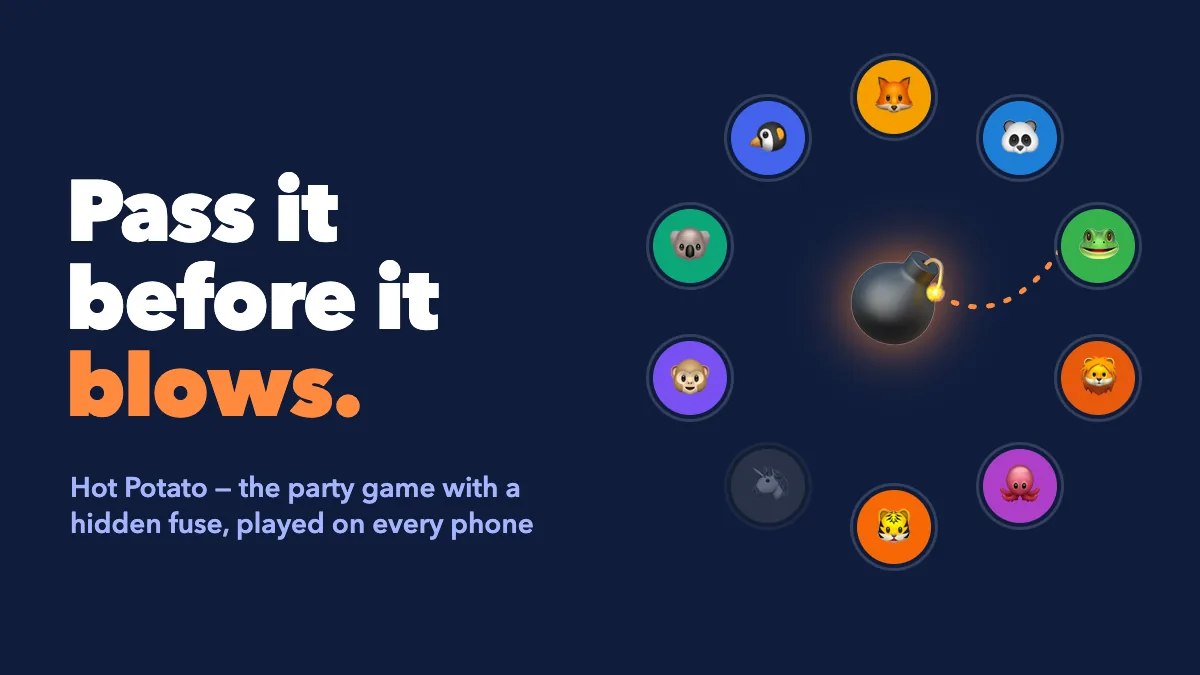
Remember hot potato? A ball goes around the circle, the music plays, and whoever is holding it when the music stops is out. It is one of the simplest party games ever invented, and one of the most nerve-racking. EngageSlide's Hot Potato slide brings it to presentations, meetings and events — with a bomb instead of a potato, phones instead of a circle of chairs, and a hidden fuse that nobody, not even the host, can see.
This guide walks through how the online version works, what players see, the one setting you need, and the situations where it works best.
How Hot Potato works
Add a Hot Potato slide from the Games tab, present it and let at least two people join with your code or QR code. Press START and the first round begins:
- The bomb lands. It starts on a random player's phone. That phone turns red, pulses, ticks and vibrates, with a huge PASS! button: You have the bomb — get rid of it!
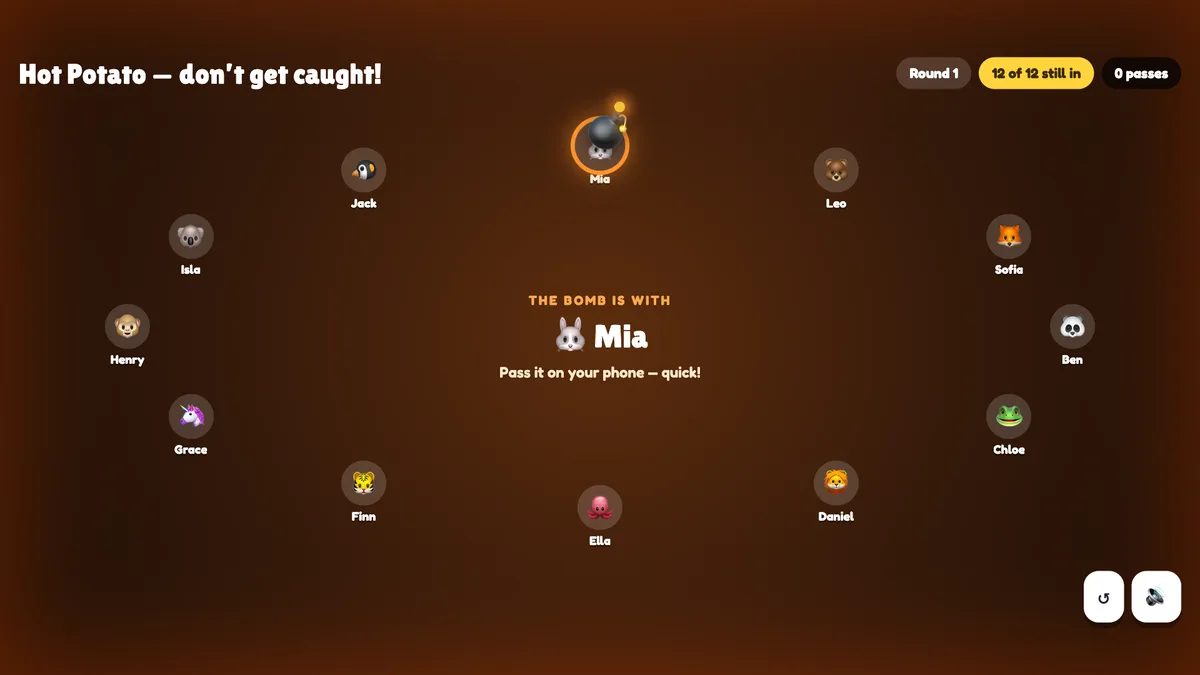
- Pass it on. One tap sends the bomb to another random player who is still in. On the big screen the bomb flies across the circle of players to its new holder.
- BOOM. Somewhere along the way the hidden fuse runs out. Whoever is holding the bomb at that moment is out: an explosion covers them on the big screen, BOOM! Leo is out! appears in the middle, and their avatar turns grey.
The next round starts by itself after a few seconds (or press Next round), with a fresh random fuse. The circle shrinks round by round until one player survives.
The hidden fuse
The fuse is what makes the game work. Each round it is a random length within the range you choose, and it is never shown on any screen. The only hint is that the background pulses and ticks faster the longer the bomb has been burning — which tells you nothing about how much time is left, but does wonders for the tension. Because nobody knows when it will blow, every pass feels like it could be the last.
Why passing fast matters
The bomb can only blow up on the player holding it at that exact moment, so getting rid of it quickly keeps you safe. But passes go to a random player — and the bomb can come straight back. That mix of reflexes and luck is why the game stays fun even for people who never win.
What players see on their phones
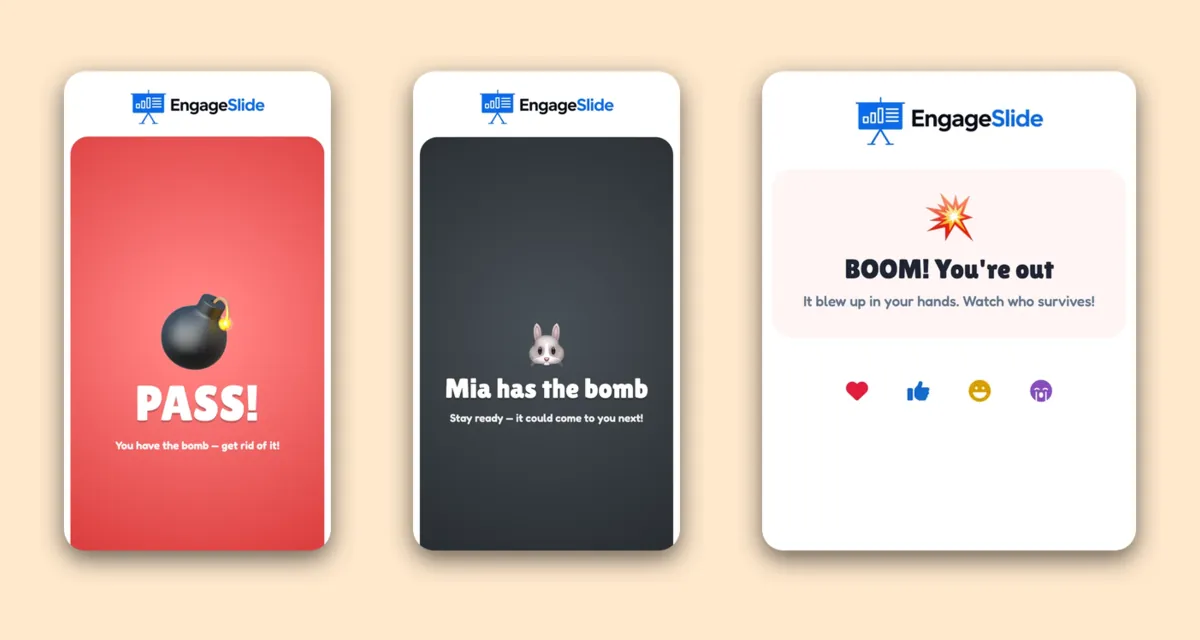
- Holding the bomb: a red, pulsing screen with a ticking 💣 and the big PASS! button. The phone vibrates so players notice even if they look away.
- Waiting: everyone else sees who has it — Mia has the bomb — and a warning: Stay ready — it could come to you next!
- When it blows: the holder sees BOOM! You're out; everyone else sees Phew — you survived! and who was caught.
- At the end: everyone sees their place and how many times they passed the bomb.
Players who are out watch the rest on the big screen, and anyone who joins late watches until you press Play again.
What the big screen shows
Before the game, the big screen shows your title, the rules, the fuse setting and everyone who joined. During a round the players stand in a circle; the bomb sits on the current holder with a sparkling fuse and a glowing ring, and the middle of the screen says The bomb is with Mia. Chips at the top count the round, the players still in and the number of passes. When one player is left, press See results: the survivor is crowned, everyone else is listed by the round they blew up in, and a Hot hands award names the player who passed the bomb most often — a nice extra shout-out for the most active player.
Setting it up
- Add a Hot Potato slide from the Games tab. There is nothing to write.
- Type a title for the big screen, such as Hot Potato — don't get caught!
- Open Settings and choose the fuse: Short (8–15 seconds), Medium (15–30 seconds, the default) or Long (25–45 seconds).
- Present, wait for at least two players, and press START (or Enter).
Start with Medium. With a big group or a short break, switch to Short so the rounds keep coming; save Long for small groups who enjoy the suspense. The big screen shows up to 40 players in the circle. Passes go to players whose phone is connected first, so the bomb doesn't get stuck with someone who walked away.
Every screen is shown step by step in the Help Center article how to use Hot Potato, and the Hot Potato slide page gives a quick overview.
The best games for groups are the ones people understand in five seconds and talk about for five minutes. Hot Potato is both.
Where Hot Potato works best
Energizers
Phones out, everyone alert: nobody wants to be caught holding the bomb. A two-minute game after lunch or between two long talks wakes a room up better than a stretch break.
Team socials and parties
It's loud, fast and over in a few minutes, so it fits into a team social, an end-of-year party or an office celebration without taking it over. Run two or three games and crown the overall survivor.
Remote meetings
Hot Potato works just as well on a video call. Share the big screen, everyone plays from their phone, and the vibration on the holder's phone makes sure remote players feel it too. It's one of the few party games that needs no extra setup for a distributed team.
Picking a volunteer
Need someone to present first, take notes or start the next exercise? The last player left — or the first one out, if you prefer — gets the job. Nobody can complain: the fuse decided.
Classrooms
Use it as a reward after a quiz or as a reset in the middle of a long lesson. Short fuse, quick rounds, and back to work.
Looking for more quick games? Rock Paper Scissors for the whole room ends with a final duel between the last two players, and Heads or Tails turns a coin toss into a prize draw everyone plays.
Tips for a great round
- Commentate. "It's with Leo… back to Mia… still burning!" Your voice is the music from the original game.
- Remind players to keep their phone in hand. The bomb can arrive at any moment.
- Play the Hot hands award. Announce it with the winner — it rewards the fastest passers even if they didn't survive.
- Keep games short. Two or three games are usually perfect; stop while people still want more.
Frequently asked questions
Who decides when the bomb blows?
Nobody. Each round the fuse is a random length in the range you chose, and it's never shown on any screen.
What if the player with the bomb doesn't react?
They keep holding it — and if the fuse runs out, they're out. That's part of the game.
Can two people play?
Yes, two is the minimum. The bomb goes back and forth until it blows.
What happens if I refresh the presenting window?
Everyone who joined shows up again straight away. If the slide is still open in another window the game carries on; a round that was burning starts again with a new random fuse.
Hot Potato is one of the games in EngageSlide's interactive presentation tool, alongside quizzes, polls, word clouds and Q&A. Add it to your next session and see who keeps their cool when the bomb lands on their phone.