
A good discussion question has a strange property: a lot of smart people get it wrong. That is the whole point of a ConcepTest, the short conceptual question at the heart of Eric Mazur's Peer Instruction. If almost everyone gets it right, there is nothing to argue about. If almost everyone gets it wrong, nobody in the room can explain it. The useful zone is in between, and what puts a question there is mostly its wrong answers. This guide shows how to write ConcepTest questions with distractors people really believe, how to aim for the right difficulty, and how to test a question before you use it in class or in a training session.
What makes a ConcepTest different from a quiz question
A normal quiz question checks whether people remember something: a date, a definition, a formula. A ConcepTest checks whether they understand the idea well enough to apply it to a situation they have not seen. "What is Newton's second law?" is recall. "A heavy ball and a light ball are dropped from the same height at the same time. Which lands first?" is a ConcepTest. Anyone can recite the law; far fewer people trust it when their gut says something else.
Mazur and Catherine Crouch described the method after a decade of use in Peer Instruction: Ten years of experience and results. The routine is simple: everyone answers alone, people who disagree try to convince each other, then everyone answers again. The second vote is usually much more accurate than the first, but only when the question was good enough to split the room. If you have not seen the full routine yet, start with our guide to Vote, Discuss, Revote peer instruction. This article is about the part most teachers find hardest: writing the question.
Step 1: Start from one misconception, not a topic
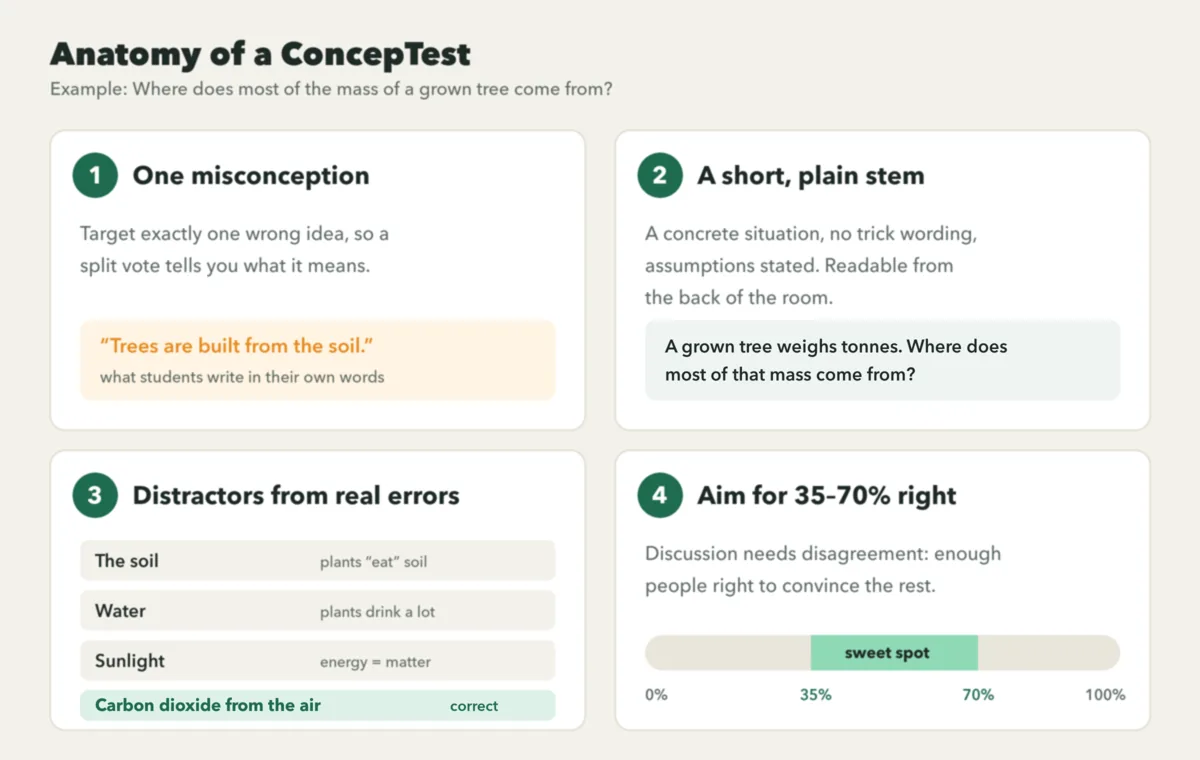
"A question about forces" is a topic. "Students think a moving object needs a force to keep moving" is a misconception. Good ConcepTests start with the second. Each question should target exactly one wrong idea, so that when the room splits you know what the split means.
Where to find the misconceptions worth targeting:
- Last year's wrong answers. Marked tests and homework are a goldmine. The same wrong answer appearing in ten scripts is a misconception, not a slip.
- Open questions before the lesson. Ask "Explain in one sentence why…" on an open-ended slide and read the answers. The wrong ones arrive in the students' own words, which is exactly how your distractors should sound.
- Published research. Many subjects have a concept inventory, a validated test built from common student errors. The Force Concept Inventory in physics is the best known, and its wrong options are a ready list of beliefs that survive instruction.
Step 2: Write a short, plain stem
The stem is the question itself. It should be readable from the back of the room and answerable after about a minute of thought. Some rules that help:
- Describe a situation. A concrete scene ("a book resting on a table") makes people apply the idea instead of matching keywords.
- Avoid trick wording. The difficulty must come from the concept, not from a double negative or a hidden "not". If people miss it because they misread, the discussion is about reading, not physics.
- Remove unnecessary jargon. Technical terms invite recall-style answers. "Which lands first?" works better than "Which body experiences greater gravitational acceleration?"
- State the assumptions. "Ignore air resistance" closes an argument you do not want to have.
Step 3: Build every wrong answer from a real mistake
This is where most questions succeed or fail. A distractor is only useful if somebody in the room genuinely believes it. Each wrong answer should map to one named error you could explain afterwards.
- Use the student's words. "The heavy ball, because it is pulled harder" is more tempting than "The heavy ball". It mirrors the reasoning people actually use.
- Two or three strong distractors beat five weak ones. Vote, Discuss, Revote accepts 2–6 answers, but a filler option that nobody picks only adds reading time.
- No joke answers and no "all of the above". They are easy to eliminate and shrink the real choice.
- Keep the options parallel. If the right answer is the longest or the only one with a careful qualifier, test-wise people will spot it without understanding anything.
- Include the "half-right" answer. The most productive arguments happen between the correct idea and a version that is almost correct.
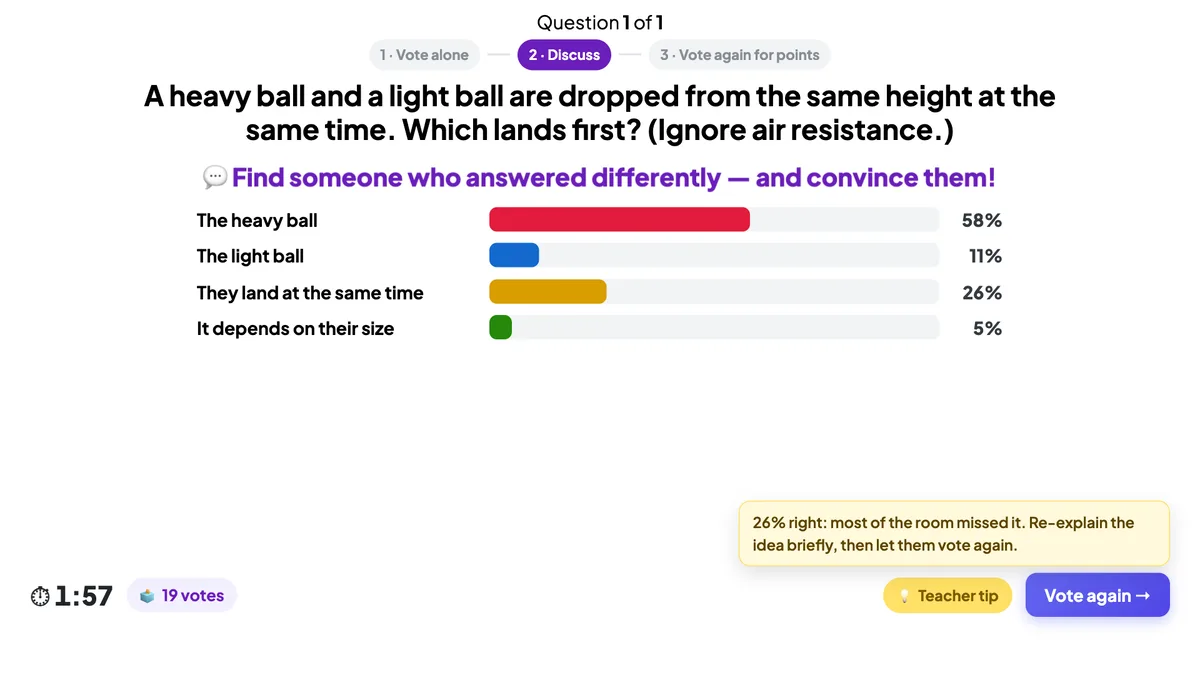
The screen above shows what a well-built distractor does. On the first vote, 58% of the room chose "The heavy ball" and only 26% chose the right answer, "They land at the same time". The big screen shows the split without revealing which answer is right, and the presenter's private Teacher tip reads the number: under 35% right means most of the room missed the idea, so re-explain briefly before the revote.
Step 4: Aim for 35–70% right on the first vote
The Peer Instruction rule of thumb is that discussion works best when roughly a third to two-thirds of the room answers correctly the first time. Below that, too few people can explain the idea. Above it, there is not enough disagreement to get people talking. A practical target for a new question is 35–70%.
If your first vote lands outside that range, tune the question rather than throwing it away:
- Too easy (over 80% right): make a distractor more convincing, remove a clue from the stem, or move the scenario further from the textbook example.
- Too hard (under 35% right): add a hint to the stem, remove the weakest distractor, or ask a simpler warm-up question first and use this one straight after.
Example ConcepTests by subject
Physics
- A ball is thrown straight up. At the very top of its path, what is its acceleration? Zero (it has stopped) · Upward · Downward, 9.8 m/s² (correct). Targets confusing velocity with acceleration.
- A book rests on a table. Which forces act on the book? Gravity only · Gravity and the table pushing up (correct) · No forces, because it is not moving. Targets "no motion means no force".
Maths
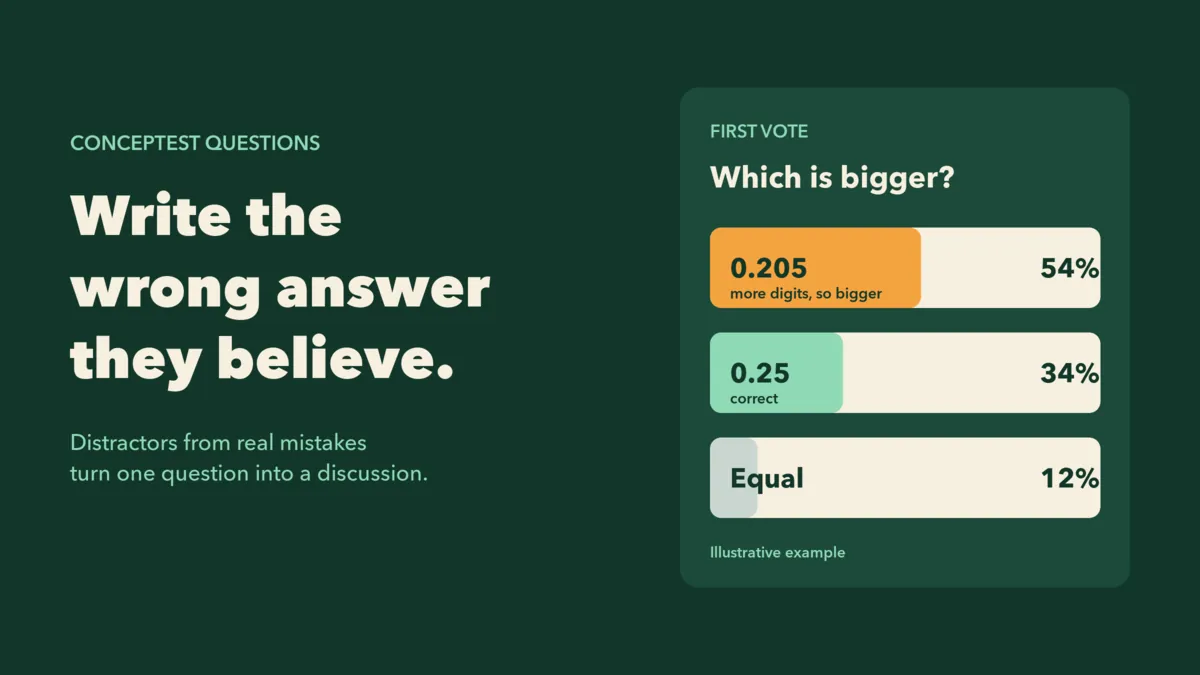
- Which is bigger: 0.25 or 0.205? 0.205, because it has more digits · 0.25 (correct) · They are equal. Targets reading decimals like whole numbers.
- A fair coin has landed heads five times in a row. What is the chance the next flip is heads? Less than 50%, tails is due · 50% (correct) · More than 50%, it is on a streak. Targets the gambler's fallacy, with a distractor on each side.
Biology
- Where does most of the mass of a fully grown tree come from? The soil · Water · Carbon dioxide from the air (correct) · Sunlight. Every wrong option is a belief adults hold too.
Workplace training
- A customer emails asking to change the bank details for their invoice payments. What do you do first? Update the details and reply to confirm · Reply to the email asking for proof · Call the customer on the number already on file (correct). Targets trusting the channel the request arrived on.
Test the question before the room does
In EngageSlide, add a Vote · Discuss · Revote slide from the Quizzes tab, type the stem, add your options and tick the right one. Before the lesson, click Try Play Game in the editor and play the slide from start to finish, or ask a colleague to answer on their phone. Then check three things:
- Can the stem be read in ten seconds? If not, cut it down.
- Could you explain each wrong answer in one sentence? If a distractor has no story, replace it.
- Does any option give the answer away? Look at length, grammar and words repeated from the stem.
All the slide settings, timings and screenshots are in the Vote, Discuss, Revote slide page.
Write the wrong answers first. If you cannot name the mistake behind a distractor, nobody in the room will believe it, and the discussion will never start.
Keep a question bank that improves every term
After each session, note the first-vote and second-vote percentages next to the question. The before → after panel at the reveal makes this easy, because it shows both percentages and how many people changed their mind. Questions that produce a big jump are your best ones. Reuse them every year, and use the misconceptions they expose as material for later review. Pairing them with short self-paced rounds of retrieval practice games helps the corrected idea stick.
Start with one misconception from your next lesson, write two wrong answers your students really believe, and let the room do the arguing. For more ideas on active learning, browse the EngageSlide blog.