
Most prize draws go the same way. The host reads a name from a bowl, one person cheers, a few people clap, and everyone else checks their phone. It takes a second, it is exciting for exactly one person, and half the room has already left. A live prize draw game fixes all three problems: everybody plays, the result happens in front of the whole room, and people stay to the end because they are still in it. Here is how to run your next giveaway as a game with EngageSlide, and the practical details that make it feel fair.
Why the classic prize draw falls flat
- It is over instantly. A name from a hat has no build-up. The prize might be great, but the moment is not.
- Only the winner is involved. Everyone else is a spectator to a process they cannot see.
- Doubts creep in. When the host picks the slip, someone always jokes that it was fixed. Usually it was not, but nobody can check.
- People leave early. If the draw is at the end and you only need a ticket to win, many attendees go home and you end up drawing names of people who are not there.
People judge fairness by the process as much as by the outcome, an idea researchers call procedural justice. A draw everyone can watch, with rules announced in advance, feels fair even to the people who lose.
The live version: everyone calls the coin
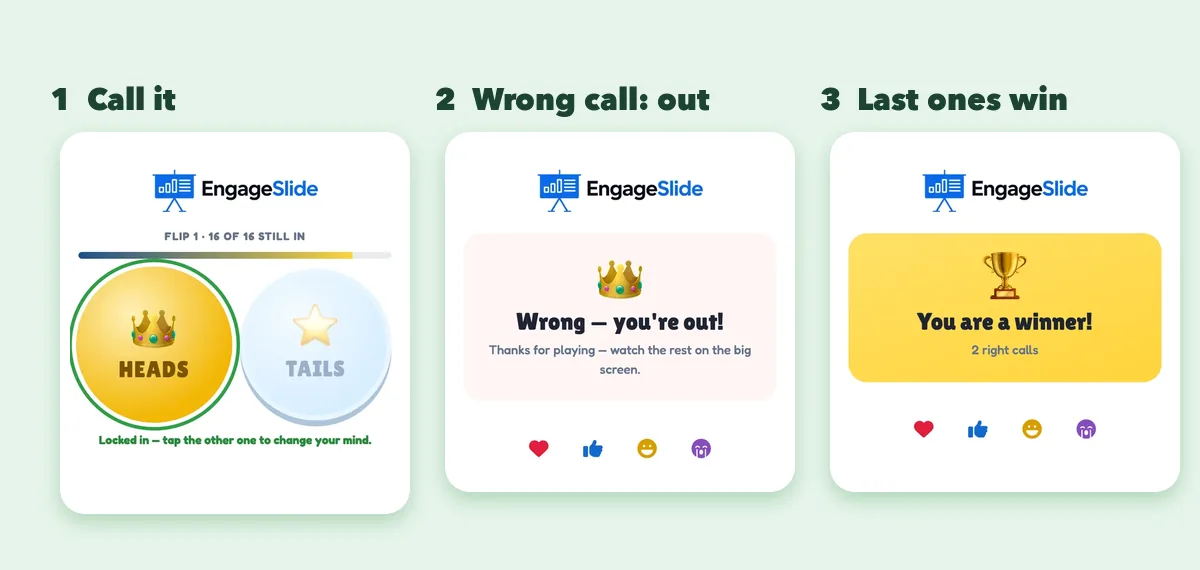
The Heads or Tails slide turns a prize draw into an elimination game for the whole room. Attendees join on their phones with the code or QR code on screen. On each flip, everyone calls HEADS or TAILS. The big screen counts the calls live, the gold coin spins for about two seconds and lands, and everyone who called it wrong (or did not call) is out. Flip after flip the room halves, until only your winners are left.
The full feature walkthrough is in Heads or Tails: Turn a Coin Toss Into a Game the Whole Room Plays. Below we focus on planning a giveaway around it.
Plan the draw before the event
1. Match winners to prizes
The Play until setting decides how many people are left at the end: 1, 2, 3, 5 or 10 winners. Set it to the number of prizes. Because one flip can knock out more players than needed, the game may occasionally end with fewer winners than you chose, so keep a quick plan for leftover prizes (for example, run one more short game for them).
2. Split tiered prizes into rounds
If you have one grand prize and several smaller ones, add two Heads or Tails slides in a row: the first for the small prizes (Play until 5), the second for the grand prize (Play until 1). Saving the biggest prize for last keeps people in the room. Decide in advance whether earlier winners may play in the next round and say it out loud; the fairest option is usually to ask them to sit it out.
3. Estimate the time
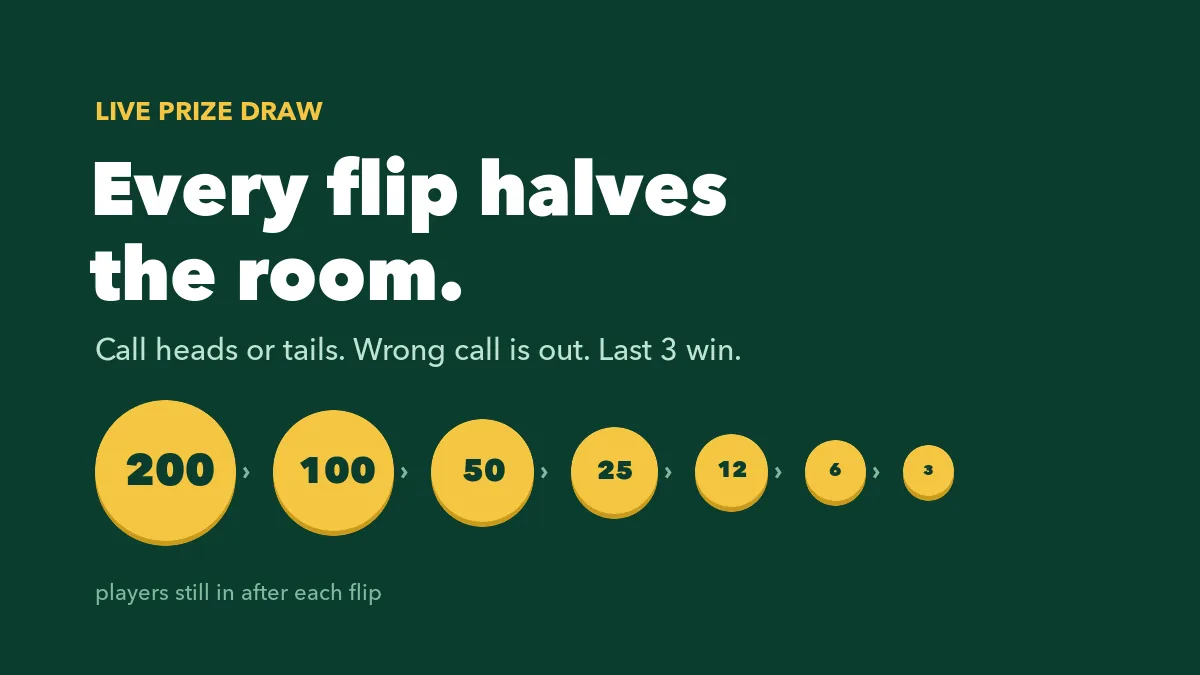
Each flip removes about half the players. A room of 200 needs around six flips to get down to three winners, and 50 people need about four flips to get to a single winner. Players have 5, 8 (the default) or 10 seconds to call, and the coin flips early once everyone still in has called, so a full draw usually takes two to three minutes, including the build-up.
Make it transparent on stage
A live draw is only convincing if the room understands the rules. Use a short script:
- Announce the prize and the rules. “Three winners. Call heads or tails on your phone. Wrong call or no call, you are out.”
- Read the split before each flip. “Forty of you are on heads, twelve on tails.” Everyone sees the same numbers on the big screen.
- Let the coin decide. The side is chosen at random at the moment calling closes. Nobody, including you, knows it in advance.
- Explain the safety rule. If everyone still in calls it wrong, nobody goes out and the coin is flipped again, so the game never ends with zero winners.
The best prize draw is one where the losers enjoyed it too. When fifty people have survived three tense flips, the winner’s cheer is shared by the whole room.
Who can enter, and how winners claim
Anyone who joins with the code can play, which means only people who are actually in the session can win. That solves the empty-chair problem. A few practical points:
- Ask for real names. Players type a name when they join. Ask them to use their full name so you can hand over the prize.
- One phone, one entry. Say it at the start. If needed, check winners against your guest list before handing over a prize.
- Late arrivals. Anyone who joins after the start watches the current game and plays in the next one.
- Proof on the phone. Winners see “You are a winner!” on their own phone. Ask them to show it at the prize desk.
- A record afterwards. Every game is saved: Past games in the slide reopens the results, and they also appear in the presentation Report.
When to run the draw
Tell people at the start that there will be a live draw at the end and that they must be in the room to play. Then use it where it helps the agenda most:
- Closing an event. The classic slot. It keeps people for the final talk and ends on a high.
- After a break. Run the first small-prize round right after lunch to bring everyone back into their seats on time.
- Webinars and hybrid events. Remote attendees join with the same code, so they have the same chance as people in the room. Choose 10 seconds to call for online audiences.
Keep the legal basics in mind
Rules for giveaways differ by country and sometimes by state, so treat this as general guidance, not legal advice. In many places a free giveaway is treated differently from a raffle or lottery where people pay to enter. Keep entry free and open to everyone attending, publish simple rules (who can enter, how winners are chosen, what happens if a winner is not available), and check with your legal or compliance team for high-value prizes or public promotions. If staff or organisers are excluded, say so before the first flip.
Other ways to pick a winner
Heads or Tails is pure luck, which is what a prize draw should be. If you need a decider between tied quiz scores or a game with a bit of skill, see Tie-Breakers That Feel Fair for options like Quick Draw and Stop the Clock. If some guests are not on their phones, a Spinner Wheel with typed names from your guest list works too.
Setup takes a minute: add a Heads or Tails slide from the Games tab, type a title such as “Three prizes, call it!”, choose the time to call and how many winners, and present. The Heads or Tails help article shows every screen. Your next giveaway can be the best two minutes of the event.