

New hires don't arrive empty-handed. By their first morning they have already picked up a dozen "facts" about your company from a friend who used to work there, a Glassdoor review, or a teammate who joined last month. Some are true. A few are flat wrong, and those quietly shape behaviour for months: people don't book leave because they "can't yet", or don't speak up because "only managers present". A short onboarding quiz built around Fact or Myth statements is one of the fastest ways to surface those rumours and correct them, in public, in the first week.
This guide shows you how to run a 10-minute myth-busting round for week one using EngageSlide's True or False slide with the Fact/Myth labels, how to find the myths worth busting, how to write the statements, and how to use the "Why?" card as the official answer people will remember.
Why a myth-busting round beats another policy slide
Most onboarding decks are a long list of correct information: here's the leave policy, here's the expense tool, here's who to ask. But correct information doesn't automatically replace incorrect beliefs: if a new hire already believes a rumour, reading the policy on slide 14 rarely overrides it, because they never notice the conflict.
A Fact or Myth round flips the order. People first commit to what they believe by tapping a side on their phone, then they see the room's split, then the verdict, then the explanation. That commit-then-correct sequence does three useful things:
- It exposes the rumour. If 60% of the room taps "Fact" on a myth, you have just learned something important about what's being said in the corridors — and so has everyone else.
- It makes the correction stick. Being surprised by an answer you committed to is far more memorable than reading a sentence. It's the same mechanism behind the testing effect: retrieving and checking beats re-reading.
- It removes the embarrassment. Nobody wants to raise a hand and ask "is it true that I can't work from home in my first month?" Tapping "Fact" on a phone, as one of thirty, is easy.
If you're new to the slide type itself, the True or False quiz guide covers every setting in detail. Here we'll focus on using it for onboarding.
Step 1: Collect the myths before day one
The best statements come from what your new hires actually believe, not from what you guess they believe. Spend fifteen minutes gathering real rumours:
- Ask the last two cohorts. "What did you believe about working here in your first week that turned out to be wrong?" is a goldmine. A short anonymous EngageSlide survey gets honest answers.
- Ask managers and HR. They hear the same confused questions every quarter: "Can I really expense lunch with a client?" "Do I need approval for every training course?"
- Scan your help-desk and HR inbox. Repeated questions from people in their first 90 days usually point to a myth.
You're looking for six to ten statements across three areas: policies (leave, expenses, remote work, probation), tools and processes (where things live, who approves what), and culture (who speaks in meetings, whether it's OK to say "I don't know", how decisions get made).
Step 2: Write statements people can genuinely disagree on
A myth-busting round only works if the statements are believable both ways. A few rules that make a big difference:
Write the rumour, not the policy
"Paid time off starts accruing on day one" is a policy. "You have to wait three months before you can take any paid time off" is the rumour people actually repeat — and it's the version that gets an honest split. Phrase myths the way people say them.
Mix in real facts
If every statement is a myth, people learn to tap "Myth" every time and stop thinking. Aim for roughly one third facts, especially surprising ones: "Every employee gets a learning budget, and you don't need your manager's approval to spend it" lands well if it's true.
One idea per statement
"You can work from home on Fridays and expense your internet bill" is two claims. If one half is true and the other false, nobody can answer correctly and the round feels like a trick.
Keep it short and neutral
One sentence, no "always" or "never" unless the rule truly is absolute. Absolute words are a giveaway that a statement is a myth.
Step 3: Build the round in EngageSlide
Create a presentation (or add the round to your existing onboarding deck), then for each statement:
- Add a True or False slide from New Slide and type the statement as the question.
- Choose the Fact/Myth labels. They suit onboarding better than True/False because you are literally correcting the stories people have heard.
- Mark the correct side. Double-check this against the current policy, not last year's.
- Write the "Why?" explanation (up to 400 characters). This is the official answer: what's actually true, and what the new hire should do about it.
- Add a source (up to 120 characters), such as "Employee Handbook, section 4.2" or "IT onboarding page". It tells people exactly where to look later.
- Set the timer to around 15–20 seconds. Long enough to read, short enough to keep the energy up.
Because True or False is a quiz slide, answers earn speed points and feed into a leaderboard. For onboarding, a leaderboard at the end is a light, friendly moment — new colleagues learning each other's names via the top three — rather than a competition. See how to add a leaderboard to your quiz if you want one.
Step 4: Run it live in week one
New hires join on their phones with the code or QR shown on screen — no app to install. Then for each statement:
- Read it out loud and let people tap Fact or Myth.
- Pause on the split. When the reveal shows the percentage and avatars on each side, react to it: "Six of you thought this was true — where did you hear it?" That's often where the best conversation happens.
- Let the verdict stamp land, then read the Why card. This is your moment to give the practical next step: "Book it in the HR portal, give two weeks' notice."
- Invite one follow-up question before moving on, so the round doesn't become a lecture.
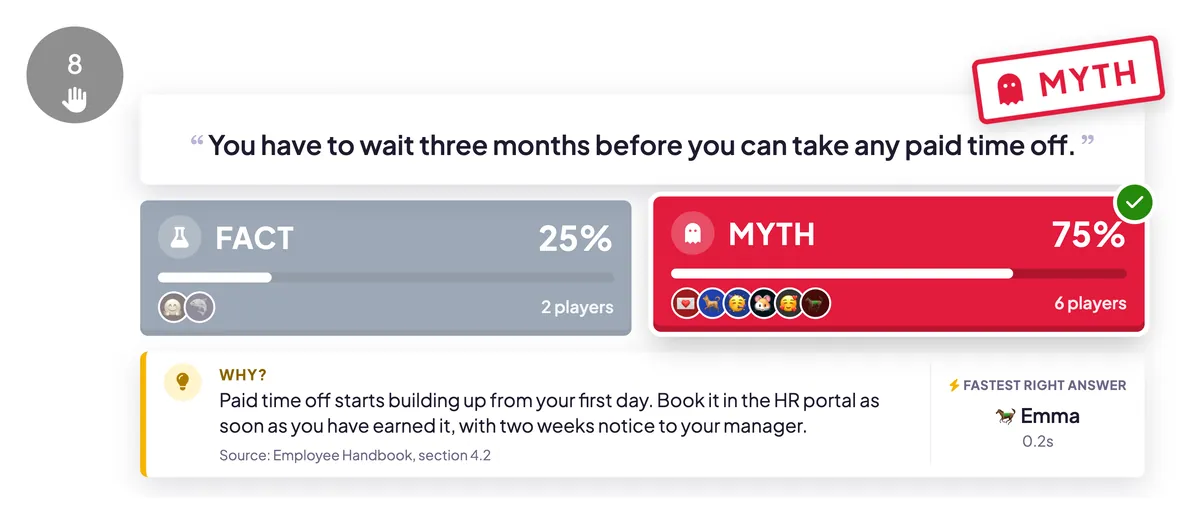
In the example above, a quarter of the cohort believed the three-month leave rumour. Without the round, those people would probably have waited until month four to ask for a day off — and quietly resented it. The Why card fixed it in ten seconds.
A myth-busting round doesn't just teach the right answer. It shows you which wrong answers your new hires walked in with — and fixes them before they turn into habits.
Ten statement ideas to adapt
These patterns come up at almost every company:
- "You have to wait three months before you can take any paid time off."
- "New starters can't work from home during probation."
- "Only managers are expected to speak in the weekly all-hands."
- "You need written approval before every expense, however small."
- "There's a learning budget you can spend without asking your manager."
- "If you're stuck, it's better to figure it out alone than to ask in the team channel."
- "All customer files must stay on the shared drive, never on your laptop."
- "You can't change your benefits choices until next year."
- "Performance reviews happen once a year, with no check-ins in between."
- "Everyone can book the big meeting room — no approval needed."
Decide which are facts and which are myths for your company, and write a Why card for each that ends with a concrete action.
Where the round fits in your onboarding plan
A myth-busting round is one segment, not a whole session. It works best on day two or three, once people have met their team but before habits form. Pair it with the rest of your first-week programme rather than replacing it. If you're redesigning the whole week, our guide to interactive presentations covers how polls, Q&A and quizzes fit together, and browsing the EngageSlide blog will give you more formats for later sessions.
Two practical tips: refresh the statements every cohort (add the newest rumour, retire any statement 90% of people now get right), and share the results with HR and managers. The report shows which statements fooled the most people; a myth that keeps winning means your official communication isn't reaching new hires. Track whether the related questions to HR or IT drop over the following 90 days — that's how you know the ten minutes paid off.
Start small: pick five rumours you heard this year, turn them into Fact or Myth slides, and run them with your next group of new hires. It takes less time to build than a single policy slide, and it's the part of onboarding people will still remember a month later.
Cover photo: Verne Ho via Unsplash, from Wikimedia Commons (CC0).