
Ask a room full of people a question and watch what happens: a few nod, most study their shoes, and one brave soul finally answers. It is tempting to conclude that the audience is shy, tired, or checked out. Usually none of that is true. Participation is a fast, mostly unconscious risk calculation — and once you understand the psychology behind that calculation, you can design sessions where speaking up feels like the easy, natural, even rewarding thing to do. This guide breaks down what actually makes people participate, and how to build each trigger into a live session with an interactive presentation tool.
Participation is a decision, not a personality trait
Every time you invite a response, each person runs a split-second cost–benefit check. On one side: what will this cost me — time, effort, the risk of looking foolish in front of peers or a boss? On the other: what do I get back — recognition, a satisfied curiosity, a sense that my input actually matters? When the perceived cost outweighs the reward, people stay quiet. That silence is rational, not rude.
This reframing changes everything about how you prepare. Instead of hoping for a "good crowd," you engineer the conditions that tip the calculation toward yes. The same person who won't raise a hand in a 200-seat auditorium will happily tap an answer on their phone thirty seconds later — because you lowered the cost and raised the reward. If you want the deeper mechanics of losing and regaining attention, we cover them in why your audience stops paying attention.
Why people hold back
Before designing for participation, name the forces working against it. In almost every quiet room, one or more of these is at play:
- Fear of judgment. Being wrong — or even just visible — in front of the group feels risky, especially in hierarchical settings.
- Effort. Unmuting, walking to a mic, or forming a full sentence is real work. Small frictions kill participation at scale.
- Invisibility of others. If nobody else seems to be participating, staying silent feels safe and normal.
- No feedback loop. If earlier input vanished into the void, people learn that responding changes nothing.
The six drivers that flip a "no" into a "yes"
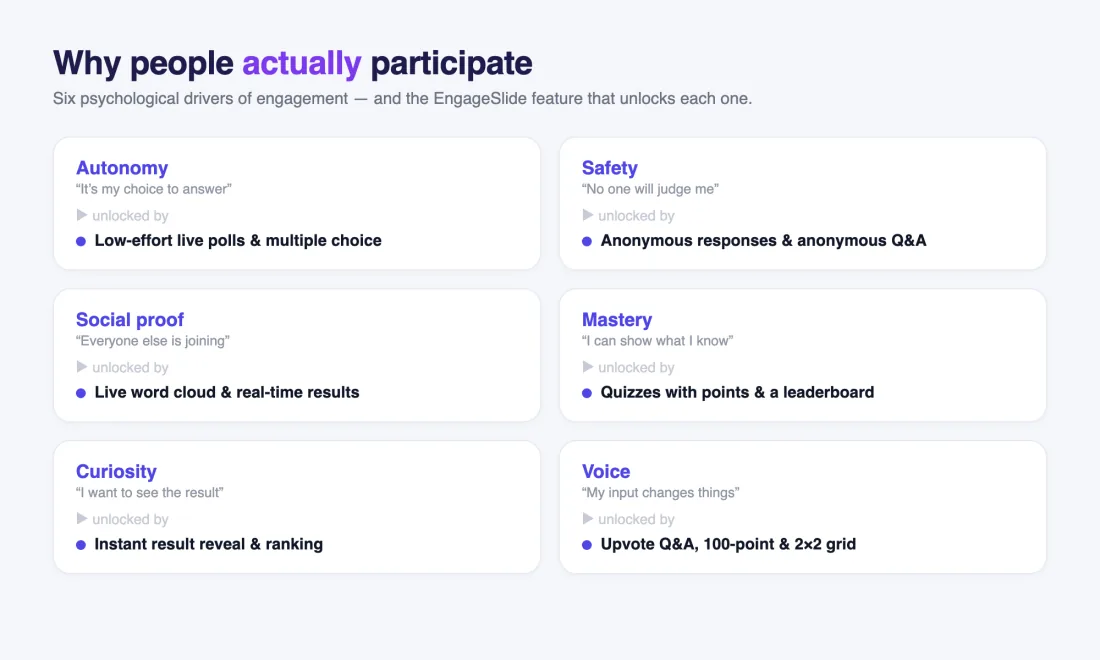
Decades of motivation research — most famously self-determination theory, which centers on autonomy, competence, and relatedness — help explain what pulls people toward action. Combine that with what we consistently see in live rooms and you get six practical drivers. Each one maps to a specific, real interaction you can run.
Safety: remove the fear of being wrong
The single biggest unlock is psychological safety — the shared belief that you won't be embarrassed or punished for speaking up. Anonymity is the fastest shortcut to it. When responses are anonymous, the personal risk drops to near zero, and quieter people finally contribute. Run anonymous polls and an anonymous Q&A so people can ask the question they'd never voice out loud. You almost always surface the most honest, most useful input this way.
Autonomy: make it a low-effort choice
People engage when responding is their choice and costs almost nothing. A one-tap multiple-choice poll respects both: no typing, no commitment, no spotlight. Let participants join instantly by scanning a QR code — no app install, no account — and the first action becomes effortless. Autonomy plus low effort is why live polls consistently get the highest response rates of any interaction.
Social proof: show momentum in real time
Humans take cues from the crowd. A live word cloud that visibly fills with words, or a poll bar chart climbing as votes land, signals "everyone is doing this" — and hesitant people jump in so they aren't the odd one out. Real-time visualization isn't decoration; it's a participation engine. The moment the screen moves, the room leans in.
Mastery and curiosity: give a reason to lean in
Two more drivers reward the effort. Mastery — the chance to show what you know — comes alive in a quiz with points and a leaderboard, which turns passive listeners into competitors. Curiosity is triggered by a cliffhanger: ask people to predict a result, then reveal it. Nobody tunes out of a question they've already invested a guess in.
People don't participate because you asked nicely. They participate when it feels safe, easy, social, and worth it — all at once.
Lower the cost of the first "yes"
Participation compounds. The hardest action to earn is the first one; after that, momentum carries. So design the opening interaction to be the lowest-risk, lowest-effort move possible, then escalate as trust builds. Think of it as a ladder.
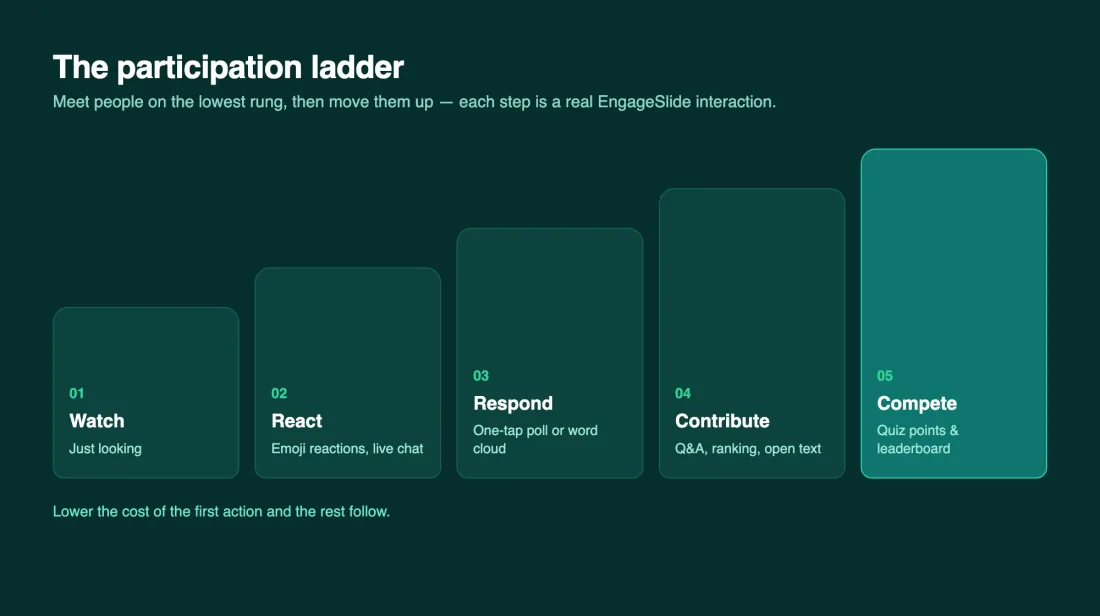
Open with something at the bottom of the ladder — an emoji reaction or a single-tap poll — before you ever ask for a spoken comment or an open-text answer. Each rung you climb earns the right to the next. By the time you reach a competitive quiz or an open brainstorm, the room is warmed up and the earlier reluctance is gone.
How to design for participation in EngageSlide
Turning the psychology into a run sheet is straightforward. A reliable sequence looks like this:
- Open with an anonymous, one-tap poll. Safety plus low effort earns the first yes within the first two minutes.
- Make joining frictionless. Put a QR code on screen so people are in with one scan — no barrier between intent and action.
- Use a live word cloud for social proof. Watching the screen fill pulls in the people still deciding whether to bother.
- Run an anonymous Q&A with upvoting. This gives everyone a voice and lets the crowd surface what matters most, without anyone risking exposure.
- Add a quiz with a leaderboard when energy dips. Points and friendly competition re-engage a room in the mid-session slump.
- Close by capturing input. A quick feedback poll or survey proves responses go somewhere — protecting the feedback loop for next time.
For a broader toolkit of moves that pair with these drivers, see our roundup of audience engagement techniques that actually work, and browse more playbooks on the EngageSlide blog.
A five-point pre-session checklist
- Is the first interaction anonymous and one-tap? If not, you're asking for too much, too soon.
- Can people join in under ten seconds? A QR code beats typing a URL every time.
- Will responses be visible live? Social proof only works if the room can see it happening.
- Does participating change anything? Reference the results, act on the Q&A, close the loop.
- Is there a reward to lean in for? A reveal, a leaderboard, or simply being heard.
Quiet audiences are rarely a lost cause — they're usually a design problem. When you make participation feel safe, effortless, social, and worthwhile, the same group that sat on its hands will light up your screen with responses. Build those triggers in deliberately, and engagement stops being something you hope for and becomes something you can count on.