
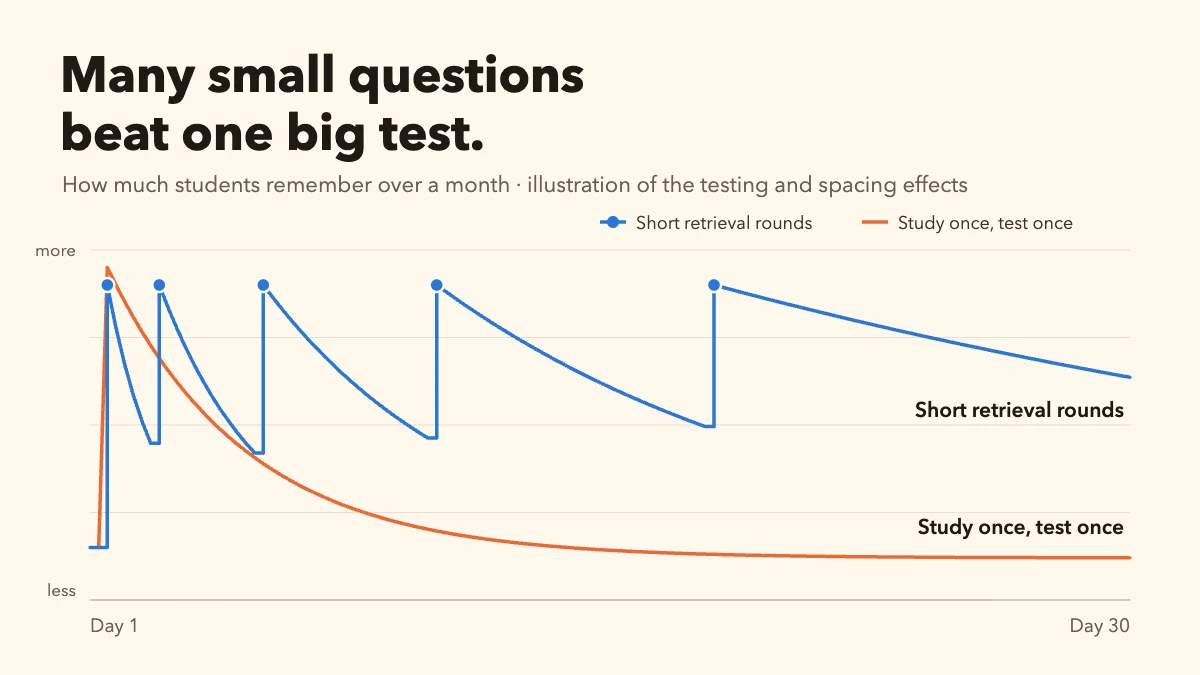
Most students revise by rereading their notes. It feels productive, the material looks familiar, and the night before a test it seems to work. A week later most of it is gone. Retrieval practice works the other way around. Instead of putting information back into memory, students pull it out, again and again, in short, low-stakes rounds. Decades of research show this is one of the most reliable ways to make learning last. This article explains the science in plain language, the four principles that matter, and how to turn them into a classroom routine with a self-paced review game in EngageSlide.
What is retrieval practice?
Retrieval practice means recalling information from memory without looking at it: answering a question, explaining a concept, or filling in a blank. The act of remembering is not just a check on learning. It changes memory itself. Each successful recall makes the next recall easier and makes the knowledge more durable.
The classic demonstration comes from a 2006 study by Henry Roediger and Jeffrey Karpicke, Test-Enhanced Learning. Students read short prose passages. Some reread them several times, while others read once and then practised recalling what they had read. Five minutes later, the rereaders did slightly better. One week later the result flipped: students who had practised recall remembered about 61% of the material, against about 40% for students who had only reread it. Rereading builds familiarity, and familiarity fades fast.
A large review of study techniques by John Dunlosky and colleagues, Improving Students' Learning With Effective Learning Techniques, looked at ten popular strategies. Only two earned a "high utility" rating: practice testing and spreading practice out over time. Rereading and highlighting, the two strategies students use most, were rated low.
Why many small questions beat one big test
A unit test at the end of a topic is retrieval too, but it comes once, it comes late, and the stakes are high. Many small questions spread across days and weeks work better for four reasons.
1. Spacing: forgetting a little helps
Memory fades between sessions, and retrieving something you have half-forgotten strengthens it more than retrieving something you just saw. A review of hundreds of experiments by Nicholas Cepeda and colleagues, Distributed practice in verbal recall tasks, found that spaced practice beat the same amount of practice crammed into one session. Five short reviews over a month beat one long one the night before.
2. Feedback: fix mistakes immediately
Retrieval works best when a wrong answer is corrected straight away. Otherwise students can remember their own mistake. The correction should be quick and clear, followed by another chance to get it right.
3. Mixing: shuffle the topics
When questions on different topics are mixed, students first have to work out what kind of question they face, and only then answer it. That extra step is harder in the moment and better for long-term learning than doing ten questions of the same type in a row.
4. Low stakes: practice, not judgement
If every quiz counts towards a grade, students cram, guess and worry. Retrieval practice should feel like a game or a warm-up, with no permanent record of mistakes. Students should feel safe being wrong, because being wrong is where the learning happens.
Rereading feels like learning. Remembering is learning. Give students many small, low-stakes chances to remember, spaced out over time, and correct every mistake on the spot.
Putting the science into a review game
EngageSlide's Treasure Hunt slide was designed around these principles. It is a self-paced review game: every student works through the question deck on their own phone, at their own speed, for a set time.
- Every student gets their own order. The deck is shuffled separately for each phone, so neighbours see different questions and topics are naturally mixed.
- Right answers open a chest. Students pick one of three chests: gold, a multiplier, or a twist such as stealing or swapping gold with a classmate. The luck keeps weaker students in the game, because a right answer always gives them a chance.
- Wrong answers get instant feedback. The phone shows the right answer straight away, with the message that the question will come back later. There is no chest, but nothing is lost either.
- Missed questions come back. A question a student got wrong returns three questions later, a small dose of spacing inside one game. When a student reaches the end of the deck, it starts again in a new order.
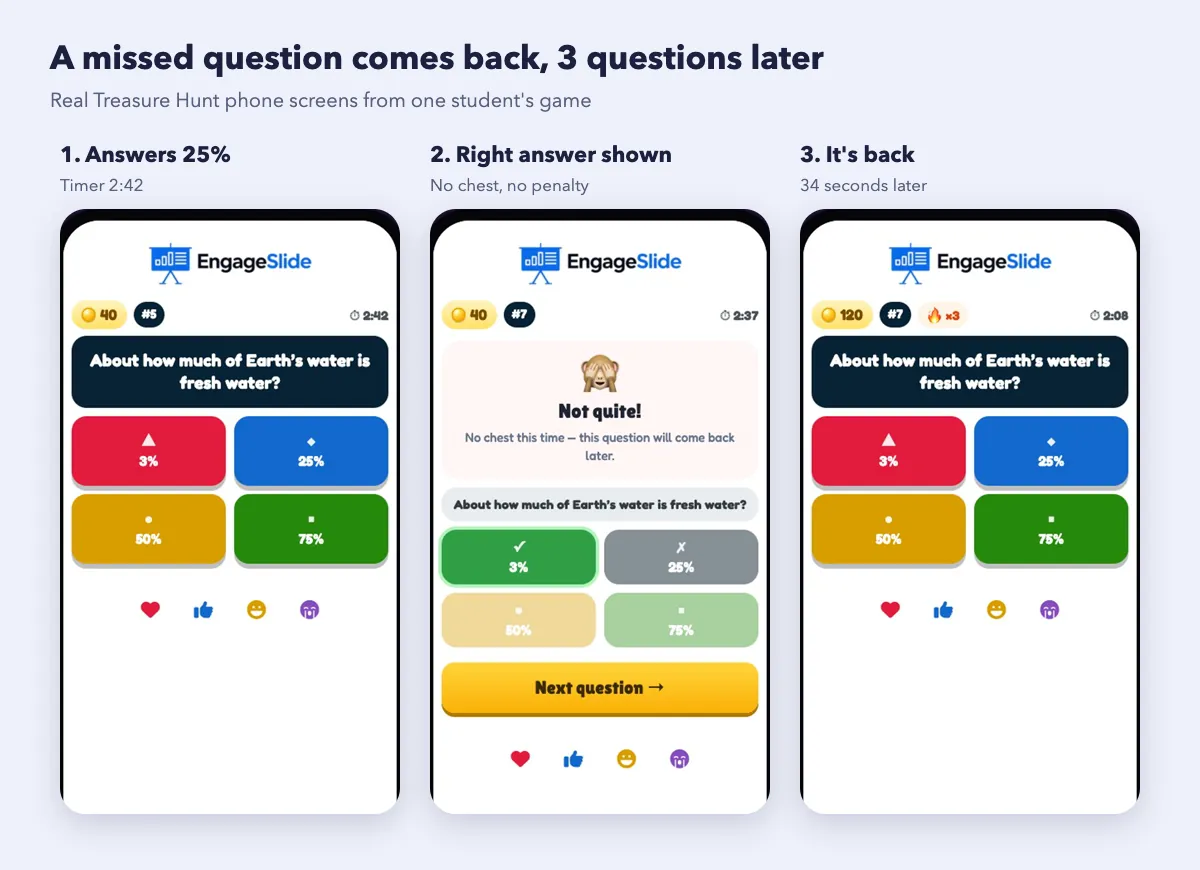
That loop of trying, getting feedback and trying again is retrieval practice in its purest form. Students often meet a question more than once in a single game, and the repeats land on exactly the questions they found hardest.
A retrieval practice routine for your classroom
Research-backed techniques only help if they become habits. Here is a simple routine that takes less than 15 minutes a week.
- Build one deck per unit. In the Question Deck, generate questions with AI from a topic, paste your own in the format Question | *Right answer | Wrong answer, or import questions from quiz slides you already have. Aim for 15–30 questions.
- Mix in old material. Add five or six questions from previous units to every new deck. This is the easiest way to space practice across the whole term.
- Play short games often. A 3- or 5-minute game at the start of a lesson twice a week does more than one long review before the test. Game time can be 3, 5, 8 or 10 minutes, and you can add a minute or end early.
- Keep it low stakes. Turn on Kind mode if your class is sensitive about losing: it removes stealing, swapping and losing gold, so no chest can take gold away. Don't record the gold as a grade.
- Close the loop with the class report. When the game ends, the results show the podium and a class report with overall accuracy and the three most-missed questions with their answers. Spend two minutes on those questions, then put them back in next week's deck.
Common mistakes to avoid
- Questions that only test recognition. "Which of these is a mammal?" with one obvious option is too easy. Make wrong answers plausible, based on real student mistakes, so students have to recall, not just spot.
- Reviewing only right before the test. That is cramming with a quiz attached. The benefit comes from spacing, so start in week one.
- Skipping the feedback. If you use paper or verbal quizzes, always reveal the answer immediately. A wrong answer left uncorrected can stick.
- Making it a grade. As soon as practice counts, students stop taking risks. Keep practice and assessment separate.
Other retrieval formats that fit the same routine
Treasure Hunt is ideal for independent practice, but you can vary the format. A whole-class elimination quiz such as Last One Standing adds tension before a test. A vote, discuss, revote question adds explanation, which deepens retrieval for difficult concepts. All of them ask students to remember instead of reread.
To set up your first game, read our guide to the Treasure Hunt review game, see the Treasure Hunt slide page, or follow the step-by-step help article.