
A good sorting activity does in one minute what a worksheet does in twenty: every learner makes a dozen small decisions, and you see exactly where their thinking goes wrong. The hard part is coming up with good groups and items. This post is an idea bank: 25 sorting activity ideas across science, language, maths, history, geography and workplace training, each with sample items and one deliberately tricky item that sparks the best discussion.
Every set fits the Sort It slide in EngageSlide, where the whole room sorts the same items on their phones and the big screen reveals what people got right. If you have not used it yet, start with Sort It: A Live Sorting Game That Shows What Your Room Gets Wrong for the full walkthrough.
What makes a good sorting set
Sorting forces a decision for every item. A set works best when it follows a few rules:
- 2–4 clear groups. Sort It supports up to four groups. Each item must belong to exactly one of them, so avoid “it depends” items unless the discussion is the point.
- 8–16 items. A slide holds up to 24, but a round of 12 is long enough to be useful and short enough to finish in 60 seconds.
- Short items. Each item can be up to 40 characters. Players read them one card at a time on a phone, so three to five words is ideal.
- One or two traps. Add an item that looks like it belongs somewhere else. The red tags and the Most missed panel after the reveal turn that item into your best teaching moment.
Sorting is also a well-known research method. In UX design, card sorting is used to learn how people group ideas in their heads. A classroom sort shows you the same mental model.
Science (5 ideas)
- 1. Mammal, bird, reptile or fish. Mammal: Dolphin, Bat, Whale. Bird: Penguin, Ostrich, Kiwi. Reptile: Gecko, Crocodile, Tortoise. Fish: Shark, Salmon, Seahorse. Trap: Platypus (Mammal, even though it lays eggs).
- 2. Solid, liquid or gas at room temperature. Solid: Iron, Salt, Wax, Sugar. Liquid: Water, Olive oil, Vinegar. Gas: Oxygen, Helium, Carbon dioxide, Neon. Trap: Mercury (Liquid, a metal that is not solid).
- 3. Conductor or insulator. Conductor: Copper wire, Aluminium foil, Steel spoon, Salt water. Insulator: Rubber, Plastic, Wood, Glass, Dry air. Trap: Graphite (Conductor, though it is not a metal).
- 4. Physical or chemical change. Physical: Melting ice, Tearing paper, Boiling water. Chemical: Rusting iron, Burning wood, Baking a cake, Milk going sour. Trap: Dissolving sugar (Physical, it only looks like it disappears).
- 5. Renewable or non-renewable energy. Renewable: Solar, Wind, Hydroelectric, Geothermal, Biomass. Non-renewable: Coal, Oil, Natural gas. Trap: Uranium (Non-renewable, even though nuclear power is low-carbon).
Language (4 ideas)
- 6. Noun, verb or adjective. Noun: Table, London, Teacher. Verb: Run, Think, Become. Adjective: Quiet, Bright, Enormous. Trap: Happiness (Noun, an abstract one that students often call an adjective).
- 7. Fact or opinion. Fact: Water boils at 100 °C at sea level, Paris is the capital of France, The Moon orbits the Earth. Opinion: Cats make better pets than dogs, Summer is the best season, This film is boring. Trap: Experts agree the climate is warming (Fact, a checkable statement about what experts say).
- 8. Simile, metaphor or personification. Simile: Busy as a bee, Ran like the wind, Cold as ice. Metaphor: Time is money, Her heart is gold. Personification: The wind whispered, The sun smiled down, The alarm clock screamed. Trap: The classroom was a zoo (Metaphor, no “like” or “as”).
- 9. Countable or uncountable noun (for language learners). Countable: Apple, Chair, Idea, Coin, Suitcase. Uncountable: Water, Information, Luggage, Furniture. Trap: Advice (Uncountable in English, though countable in many other languages).
Maths (4 ideas)
- 10. Prime or not prime. Prime: 2, 3, 13, 29, 31. Not prime: 1, 9, 21, 27, 49. Trap: 51 (Not prime, 3 × 17).
- 11. Rational or irrational. Rational: 0.5, 3/4, −7, 0.333… Irrational: π, √2, √3, e. Trap: √16 (Rational, it equals 4).
- 12. Parallelogram or not. Parallelogram: Rectangle, Rhombus, Parallelogram. Not: Trapezium, Kite, Triangle, Pentagon. Trap: Square (Parallelogram, a special case many students miss).
- 13. Equal to one half or not. Equal: 2/4, 0.5, 50%, 4/8, 7/14. Not: 5%, 1/5, 2/5, 3/5. Trap: 0.05 (Not, one decimal place makes all the difference).
History and civics (4 ideas)
- 14. Ancient Egypt, Greece or Rome. Egypt: Pyramids of Giza, Hieroglyphs, Tutankhamun. Greece: Parthenon, Olympic Games, Socrates. Rome: Colosseum, Julius Caesar, Latin. Trap: Cleopatra (Egypt, although her family was of Greek origin).
- 15. Invented before or after 1900. Before: Printing press, Steam engine, Telephone, Light bulb. After: Aeroplane, Television, Penicillin, Internet. Trap: Motor car (Before, Karl Benz built his in 1886).
- 16. World War I or World War II. WWI: Trench warfare, Battle of the Somme, Archduke Franz Ferdinand. WWII: D-Day, Pearl Harbor, Battle of Britain, Hiroshima. Trap: Treaty of Versailles (WWI, it ended that war).
- 17. Legislative, executive or judicial. Legislative: Makes laws, Parliament, Debates bills. Executive: Carries out laws, Runs government departments. Judicial: Interprets laws, Supreme Court, Judges. Trap: Approves the budget (Legislative, not the executive).
Geography (4 ideas)
- 18. Africa, Asia, Europe or South America. Africa: Kenya, Morocco, Ghana. Asia: Japan, India, Vietnam. Europe: Portugal, Norway, Poland. South America: Peru, Chile, Brazil. Trap: Egypt (Africa, often placed in Asia).
- 19. Capital city or not. Capital: Canberra, Ottawa, Brasília, Ankara, Wellington. Not: Sydney, Toronto, Rio de Janeiro, Auckland. Trap: Istanbul (Not the capital, Ankara is).
- 20. Weather or climate. Weather: Raining today, Storm tomorrow, Foggy this morning. Climate: Hot, dry summers every year, Average 1,200 mm rain a year. Trap: Monsoon season each year (Climate, it is a long-term pattern).
- 21. Igneous, sedimentary or metamorphic rock. Igneous: Granite, Basalt, Obsidian, Pumice. Sedimentary: Sandstone, Limestone, Chalk, Shale. Metamorphic: Slate, Quartzite, Gneiss. Trap: Marble (Metamorphic, it forms from limestone).
Workplace and training (4 ideas)
- 22. Phishing red flag or normal email. Red flag: Urgent: verify your password, Misspelled sender domain, Gift card request from the CEO, Unexpected invoice attachment. Normal: Meeting invite from your manager, Payslip on the HR portal. Trap: Password reset you just requested (Normal, context matters).
- 23. Public, internal or confidential. Public: Press release, Job advert, Price list. Internal: Office Wi-Fi guide, Team meeting notes. Confidential: Customer list, Salaries, Unreleased results. Trap: Draft press release (Internal until it is published). Adjust the groups to your own data policy.
- 24. Open or closed question (customer service). Open: How can I help today?, What happened next?, Tell me more about the issue. Closed: Did you restart it?, Is this the right address?, Can I call you back? Trap: Which plan are you on? (Closed, a “wh” question with a short fixed answer).
- 25. First aid for a burn: do or don’t. Do: Cool under running water, Remove rings near the burn, Cover with cling film. Don’t: Apply butter, Use ice, Pop the blisters. Trap: Cover with cling film (Do, it is recommended by the NHS).
The trap item is the whole lesson. One card that half the room puts in the wrong group gives you a misconception to discuss in the learners’ own words, which a correct answer never does.
How to paste a set into Sort It
Pasting is faster than typing. The order matters:
- Create the groups first. Under Groups, rename the default groups and use + Add group for up to four. Pick a colour for each one.
- Write one item per line as Item | Group. For idea 1 that looks like Dolphin | Mammal, Penguin | Bird, Platypus | Mammal and so on.
- Click Paste list and paste. Groups are matched by name, and capitals don’t matter. The box shows how many items it found and how many lines have no known group, so a typo in a group name is easy to spot. Click Add.
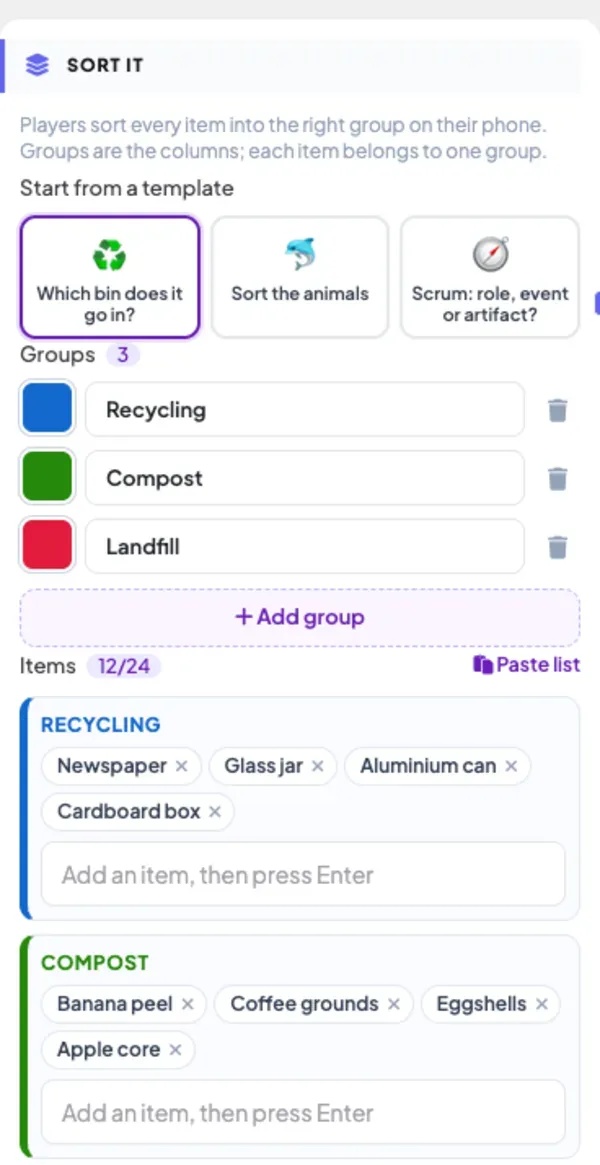
Duplicate items are skipped, and the slide stops at 24 items.
Running the sort in class or training
Present the slide, let people join with the code or QR code and press START. Each phone deals the items in its own random order, so neighbours can’t copy.
- Set the time to the list. 60 seconds suits 10–12 items. Use 90 or 120 for younger learners or longer lists.
- Predict before you reveal. Ask, “Which item do you think fooled most people?” Then show the reveal and compare.
- Read Most missed aloud. It lists the three items with the lowest score and the wrong group people chose most often.
- Play again. Run the same items in a new order after the discussion to check that the explanation landed.
Sort It keeps its own leaderboard for each round, so you can add it to a quiz-heavy lesson without changing quiz scores. Every setting is explained in the Sort It help article. For more game ideas, browse the EngageSlide blog. Pick one set, add your own trap, and your next starter is ready.
Cover photo: Selixshiraii, via Wikimedia Commons, CC0.