
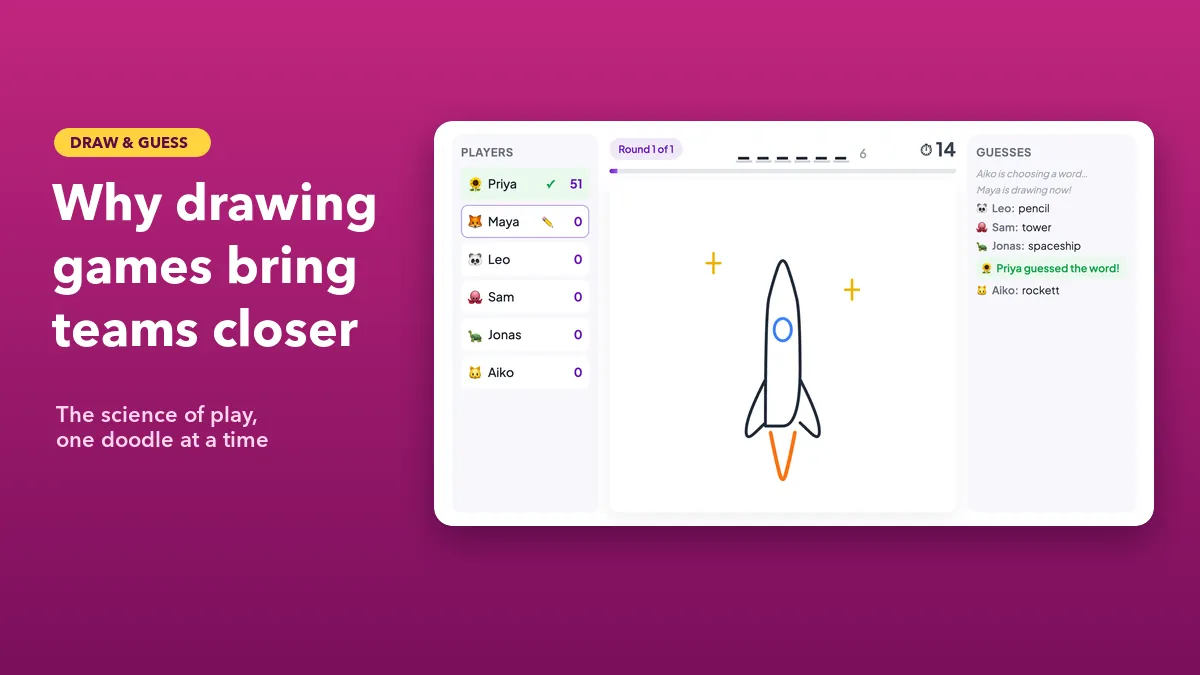
Put a group of colleagues in front of a shared screen, hand one of them a pen, and ask them to draw "rocket" in twenty seconds. Within moments someone shouts "pencil!", someone else types "tower", and the whole room is laughing at a sketch that looks nothing like a rocket. Five minutes later, people who barely spoke in the last meeting are teasing each other by name. That is not an accident. Drawing games trigger a handful of well-understood social and psychological effects that make teams feel closer, faster than most structured team-building exercises. This article explains the science behind drawing games and team bonding, why the format works so well, and how to run one with your own group using EngageSlide's Draw & Guess slide.
Why play matters at work at all
It is tempting to treat games as a break from "real" work. Researchers who study play see it differently. Play is voluntary, has light rules, and carries low stakes, and those three properties are exactly what let people relax the guarded behaviour they bring to meetings. When the outcome does not matter, people stop managing their image and start reacting honestly. Honest reactions are what colleagues remember and connect over.
The challenge is that many "fun" activities still reward the usual winners: the fastest talkers, the most senior people, the trivia buffs. A good team-bonding game levels the field. Drawing games happen to do that unusually well, for four reasons.
The four effects behind drawing games and team bonding
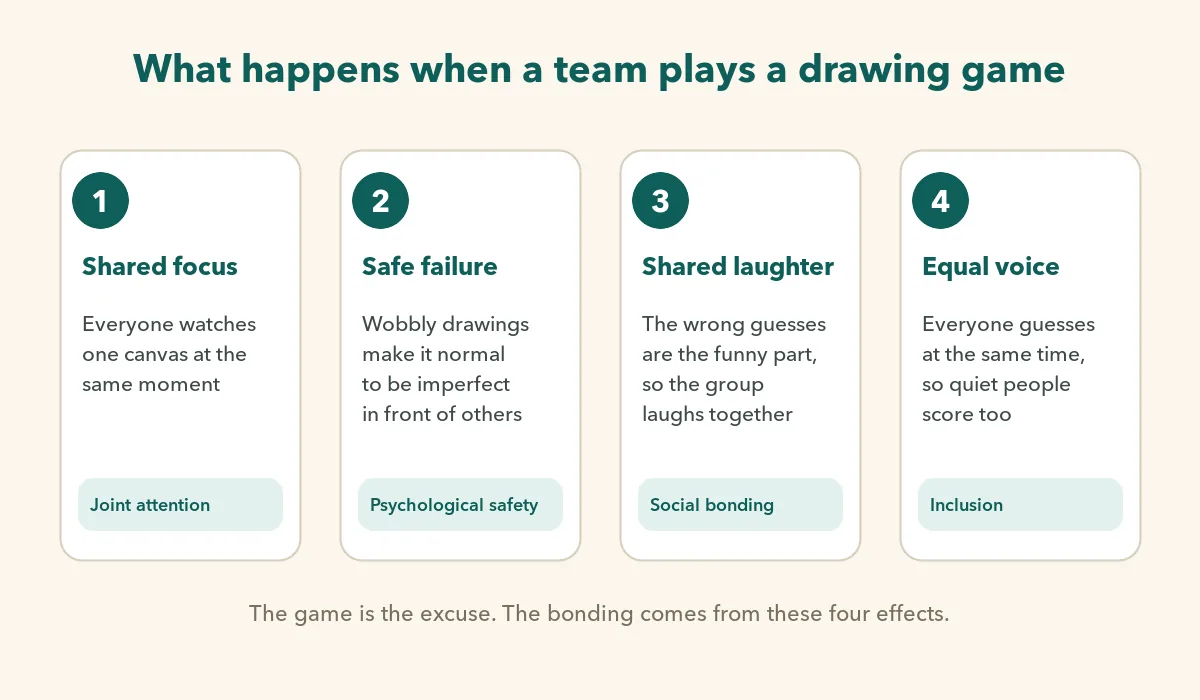
When a team plays a drawing game together, four things happen at once. Each one has a name in psychology, and each one does a specific job for the group.
1. Shared focus: everyone looks at the same thing
In a normal meeting, attention is scattered across slides, chat, email and phones. In a drawing game, every person is watching the same canvas at the same moment, trying to work out what it is. Psychologists call this joint attention: attending to the same thing and knowing others are attending too. It is one of the earliest building blocks of social connection, which is why the room goes quiet and then erupts together.
2. Safe failure: being bad at drawing is the point
Very few adults think they can draw, and that is the secret ingredient. When the team lead draws a cat that looks like a potato, they are visibly imperfect in front of everyone, and nobody is hurt by it. Social psychologists describe the pratfall effect: people who are seen as competent often become more likeable after a small, harmless blunder. A wobbly drawing is the ideal harmless blunder.
Repeated small moments like this also feed into psychological safety, Amy Edmondson's term for a shared belief that the team is safe for interpersonal risk-taking. A game will not fix a team with deeper trust problems, but it gives everyone a low-cost rehearsal of being imperfect in public and seeing that nothing bad happens.
3. Shared laughter: the wrong guesses are the fun
Watch a Draw & Guess round and you will notice that the biggest laughs come from the wrong answers, not the right one. "Spaceship" is close. "Pencil" is hilarious. Laughing at the same thing at the same time is a strong bonding signal: it tells everyone in the room that they share a reference point. Those moments become inside jokes that keep paying off in later meetings.
4. Equal voice: everyone answers at once
In a verbal brainstorm, the loudest three people do most of the talking. In a drawing game, every guesser types at the same time on their own device, so the quiet analyst has exactly the same chance to score as the extrovert in sales. Turn-taking also guarantees that every player gets a moment in the spotlight as the drawer. For more on why simultaneous participation changes behaviour, see our deep dive on the psychology of audience engagement.
The drawing is just the excuse. The bonding comes from shared focus, safe failure, shared laughter and an equal voice for everyone, all packed into a few minutes.
Why drawing beats talking for groups
Charades or a pub quiz offer some of this, but drawing has practical advantages:
- No knowledge advantage. Trivia rewards people who know facts. Drawing rewards creativity and quick reading of other people's thinking, which almost anyone can do.
- Works in mixed languages. A picture of a dog is a dog in any language, so international teams play on more equal terms.
- Works remotely. Charades is awkward in a grid of video tiles. A shared canvas on everyone's screen is not.
- It is fast. One round takes a few minutes, so it fits at the start of a meeting rather than needing a whole afternoon.
If you are still deciding between formats, our comparison of Draw & Guess vs trivia walks through which one fits which group.
How a Draw & Guess round works in EngageSlide
EngageSlide's Draw & Guess slide turns this into a ready-made live game inside your presentation, so you do not need a separate app or a whiteboard. You add it like any other slide in the interactive presentation tool, and participants join from their phones with the room code or QR code.
- The drawer picks a word. One player is chosen to draw and privately sees a few word choices on their phone. Nobody else sees them.
- They draw on their phone. Every stroke appears live on the big screen and on every guesser's phone, with colours, brush sizes, an eraser and undo.
- Everyone guesses at once. Guesses appear in a live feed on the shared screen, so the wrong answers become part of the entertainment. A player who is one letter off gets a private "you're close" nudge, and letter hints appear as time runs down.
- Points reward speed. Faster correct guesses earn more points, and the drawer earns points when people get it, which rewards clear drawing over showing off.
- Turns rotate. Everyone gets a go as the drawer, and the game ends with a final scores leaderboard.
As host, you choose the number of rounds, the drawing time (from 20 seconds up to two minutes), and whether words come from a built-in theme such as animals, food, objects, nature, sports, places or actions, or from your own list. Our full guide to Draw & Guess covers the setup step by step.
Designing a session that actually builds connection
The science only helps if the game is set up to trigger it. A few choices make a big difference.
Keep the stakes low
Use short drawing times (20 to 30 seconds) and a single round for a warm-up. Short timers keep the drawings rough, and rough drawings are funnier. Avoid prizes that matter; the leaderboard is reward enough.
Use your team's own words
Switch the word source to your own list and add words only your team understands: the name of a legacy system, the office plant, the coffee machine that always breaks. Drawing shared references reinforces the sense of a shared identity, which is exactly what you are trying to build.
Let the host play badly first
If you are a manager, take a turn early and do not try too hard. Your imperfect drawing gives everyone else permission to be imperfect too, which is the pratfall effect working in your favour.
Talk for one minute afterwards
Spend sixty seconds on the funniest guess or the most surprising drawing before moving on to the agenda. That short debrief turns a fun moment into a shared story, and shared stories are what people carry into the next meeting.
When to use a drawing game
Drawing games work best where a group needs to warm up or reconnect quickly:
- New or recently merged teams that have not yet built shared references.
- Remote and hybrid teams who rarely share a laugh outside of work topics. Our guide to virtual Pictionary for remote teams covers that setting in detail.
- Workshops and offsites as an energiser after lunch or between heavy sessions.
- Training cohorts on day one, before you ask people to speak up in discussions.
Measuring whether it worked
You will not see bonding on a dashboard, but look for signals: do quieter people speak up sooner, and does the group reference the game later in chat? For something concrete, follow the session with a quick anonymous scale question asking how connected people feel to the team, and repeat it over a few weeks.
Play is not a distraction from teamwork; done well, it is a shortcut to the trust and familiarity that good teamwork depends on. A five-minute drawing game gives your team shared focus, a safe way to be imperfect, something to laugh about together and an equal voice for everyone. For more ideas on bringing interaction into your sessions, browse the EngageSlide blog.