
You are ten minutes into your talk when you feel it: the room cools. A phone lights up in the third row. Someone's eyes glaze over mid-sentence. The energy that filled the room at the start has quietly leaked away — and no matter how good your next slide is, half the audience is already gone. Every presenter has lived this moment. The good news is that losing a room is not random; it happens for a handful of predictable reasons, and each one has a fix you can apply on the spot.
This is a diagnostic guide: first, why audiences check out, then exactly how to win them back — live, in seconds. If you want the broader tactics afterwards, pair this with our 15 audience engagement techniques and the beginner's guide to making presentations interactive.
Attention is a leaky bucket
Here is the uncomfortable truth: human attention drains by default. Studies of attention span show that focus during passive listening starts slipping within minutes, and every distraction — a notification, a stray thought, a boring stretch — speeds the leak. You are not competing with the person next to you; you are competing with an entire inbox, a group chat, and the infinite scroll in everyone's pocket.
So the question is not "how do I hold attention forever?" — you can't. The question is "how do I keep refilling the bucket?" And to refill it, you first need to know what is draining it.
This matters more than it feels like in the moment. A disengaged audience doesn't just make you feel awkward — it means your message never lands. Decisions don't get made, training doesn't stick, and the action you were hoping for never happens. Presenters often blame the content ("maybe it was too technical") when the real culprit was the format: a room that had quietly stopped listening long before the important slide. Fix the format, and the same content suddenly works.
The 6 reasons audiences tune out (and the instant fix)
Almost every disengaged room traces back to one of these six causes. Learn to spot them and you can respond before you lose people for good.
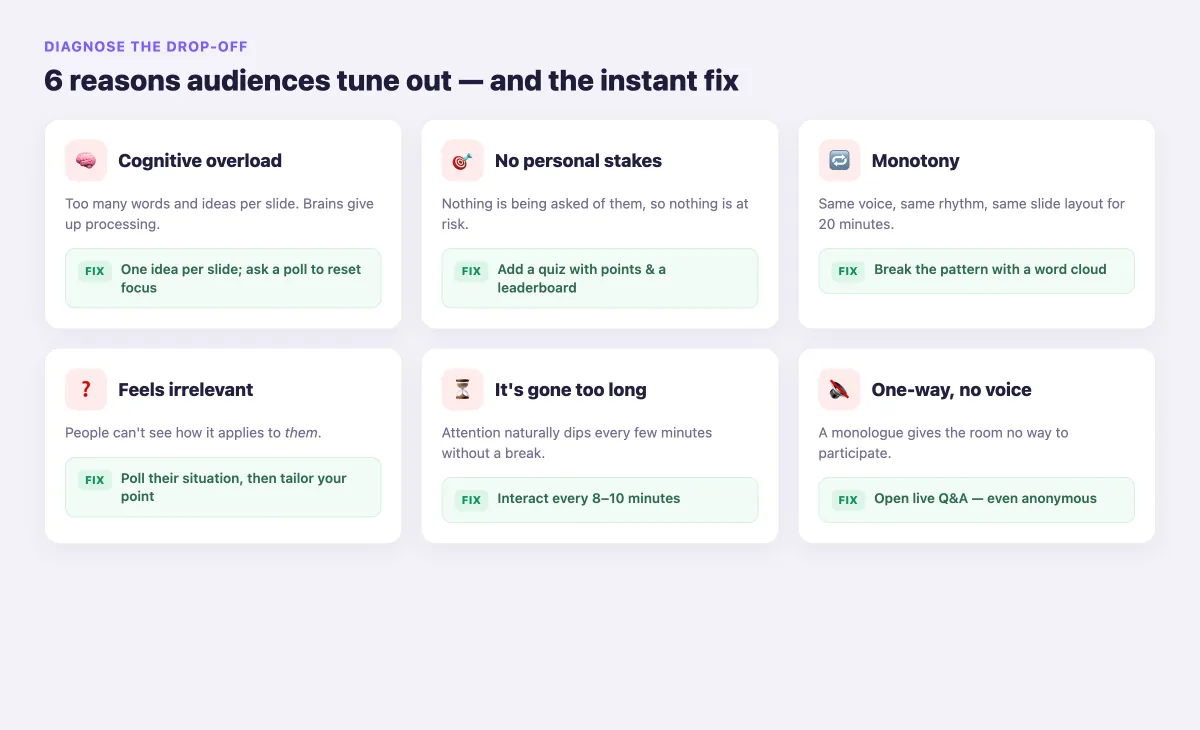
- 1. Cognitive overload. Slides crammed with text and ideas force the brain to choose between reading and listening, so it does neither. Fix: one idea per slide, and break dense stretches with a quick live poll that resets focus.
- 2. No personal stakes. When nothing is asked of the audience, nothing is at risk for them — so attention is optional. Fix: add a quiz with points and a leaderboard; a little competition makes people lean in.
- 3. Monotony. Same voice, same pace, same slide layout for twenty minutes lulls a room to sleep. Fix: break the pattern with a different format, like a live word cloud that puts the audience's words on screen.
- 4. It feels irrelevant. If people can't see how your point applies to them, they mentally file it under "not my problem." Fix: poll their situation first, then tailor your example to the majority answer.
- 5. It has gone on too long. Attention dips every few minutes regardless of how good you are. Fix: plan a participation point roughly every 8–10 minutes, before the dip bottoms out.
- 6. It's one-way with no voice. A monologue gives the audience no role but "spectator," and spectators disengage. Fix: open a live Q&A — anonymous if the topic is sensitive — so the room has a way in.
Notice the pattern: every fix turns a passive moment into an active one. That is the whole game.
How to read the room in real time
Before you can win a room back, you have to notice you're losing it. The warning signs are consistent, and once you know them you'll catch the drift early instead of at the coffee break when someone tells you it "dragged a bit."
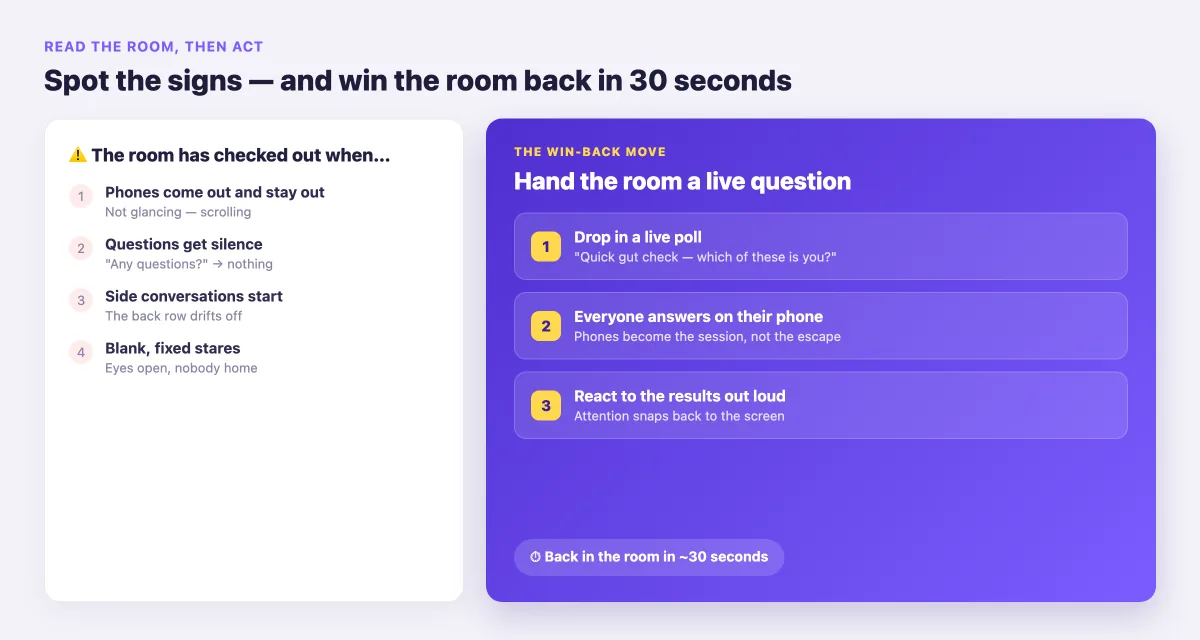
- Phones come out and stay out. A glance is normal; sustained scrolling means you've lost them.
- Your questions get silence. "Any questions?" landing on dead air is a symptom, not a lull.
- Side conversations start. When the back row begins its own meeting, engagement has left the building.
- Blank, fixed stares. Eyes open, nobody home — the most common and most missed signal.
The 30-second win-back move
When you spot the signs, do not push harder on the same monologue that lost them — change the format. The single most reliable recovery is to hand the room a live question. In EngageSlide this is a three-step reflex:
Drop in a live poll → everyone answers on their phone → react to the results out loud. In about thirty seconds, the phones that were the escape become the session, and attention snaps back to your screen.
The magic is not the poll itself — it's the shift in role. The instant people have to answer, they stop being spectators and start being participants, and participants pay attention. A "quick gut check — which of these is you?" poll works in almost any context, from a sales demo to a lecture to an all-hands. Because attendees join by scanning a QR code in their browser, there's nothing to install and no friction between "I'm bored" and "I'm in."
Turn recovery into prevention
Winning a room back is a great skill, but the better move is to never lose it in the first place. Once you understand that attention is a leaky bucket, you can design your talk to keep refilling it: open with a poll, break monotony with a word cloud, add stakes with a mid-session quiz, surface real questions with live Q&A, and close by collecting feedback with a quick survey. Space those moments out and the dips never get deep enough to lose anyone.
Attention isn't a personality contest you either win or lose — it's a system you can design. Diagnose the six causes, watch for the warning signs, and keep a live question in your back pocket. Do that, and the next time a room starts to drift, you won't panic. You'll just reach for the poll button and bring everyone back.