
A live word cloud is only as good as the question behind it. Ask something flat like "Any thoughts?" and you'll get a scattered mess of one-off words. Ask the right question and the same tool turns a quiet room into an engaged one, surfaces honest opinions, and hands you a talking point everyone can see. This is a copy-and-use list of 12 creative word cloud questions — split across meetings, classrooms, and team-building — plus the small tweaks that make each one work. New to the format? Start with what a live word cloud is and how it works, then come back for the prompts.
What makes a good word cloud question
Before the list, three quick rules that separate a cloud that pops from one that flops:
- Ask for one word (or two). Single-word prompts produce clean clouds where shared answers stack and grow. Sentence-length prompts fragment into singletons that never merge.
- Keep it open, not correct. Word clouds are for opinions, feelings, and associations. If there's a right answer, run a live quiz instead.
- Make it personal and specific. "Describe our team" is vague. "One word for our team on its best day" gives people a clear, vivid thing to answer.
Every question below follows those rules. Run them in EngageSlide's interactive presentation tool — your audience joins with a QR code or join code and answers from their phones while the cloud builds live on screen.
Word cloud questions for meetings
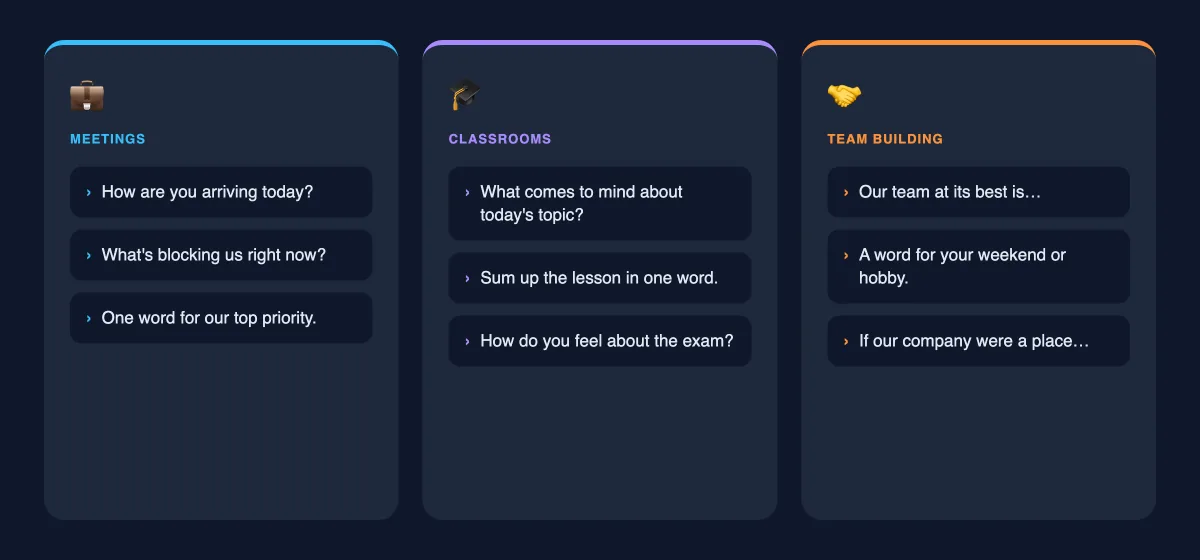
Use these to open a meeting with energy, take an honest temperature check, or surface issues people won't raise out loud.
1. "In one word, how are you arriving today?"
The perfect opener. It signals that how people feel matters, and it gives you an instant read on the room's energy before you start. A cloud full of "tired" tells you to bring the pace up.
2. "What's one word for our biggest priority this quarter?"
A brilliant alignment check. If everyone's on the same page, one word dominates. If the cloud is scattered, you've just discovered — visibly — that your team isn't aligned, and that's a conversation worth having.
3. "What's blocking us right now?"
Because it's anonymous, people name the real blockers — "bureaucracy," "unclear-goals," "meetings" — that they'd never say aloud. The words multiple people share grow largest, instantly ranking your team's pain points.
4. "Describe this project in one word."
A fast gut-check at a milestone. "Exciting" and "chaotic" side by side tells you more than a status report. Follow up by asking someone to expand on a surprising word.
5. "One word you'd use to describe our customers."
Great for kicking off strategy or product discussions. It reveals how aligned (or not) the team's mental model of the customer really is.
Word cloud questions for classrooms
Word clouds give every student a voice — including the quiet ones — and turn abstract topics into a shared visual. These work from middle school to university lecture halls.
6. "What comes to mind when you hear [today's topic]?"
Run it at the very start of a lesson to activate prior knowledge and see what students already associate with the subject. It's a diagnostic and an engagement hook in one.
7. "Sum up today's lesson in one word."
A digital exit ticket. It shows you at a glance whether the class landed where you wanted. A cloud full of "confusing" is honest feedback you can act on tomorrow.
8. "What's one word that describes how you feel about the exam?"
Naming the anxiety in the room ("nervous," "ready," "stressed") makes it discussable and reassures students they're not alone — a small move with a big effect on classroom trust.
9. "Before and after: one word for [concept]."
Ask the same prompt at the start and end of a unit. The shift from "hard" and "confusing" to "clear" and "useful" is a vivid, visual proof of learning that students feel proud of.
For graded checks rather than opinion clouds, pair this with an auto-graded assignment so you capture both the mood and the mastery.
Word cloud questions for team building
These build connection and shared identity — ideal for offsites, all-hands, kickoffs, and new-team formation.
10. "One word that describes our team at its best."
An uplifting prompt that produces a shareable artifact — a snapshot of your culture in the team's own words. Screenshot it and pin it to your channel.
11. "What's a word that describes your weekend/hobby?"
A low-stakes, human icebreaker for new groups. It sparks "wait, who put skydiving?" moments that get people talking across the table.
12. "If our company were a place, what would it be?"
A playful, slightly abstract prompt that gets creative answers — "startup-garage," "library," "carnival" — and reveals how people really experience the culture. Great for opening a values discussion.
The best word cloud questions aren't clever — they're specific, honest, and answerable in one word. Give people something real to react to and the room does the rest.
Turn the cloud into a conversation
Collecting the words is only half the value. The other half is what you do next. When the cloud settles, name the biggest words out loud, then pick one to dig into: "I see 'overwhelmed' is large — tell me more about that." A word cloud is a springboard for discussion, not a full stop. Reading it back and reacting is where the genuine engagement — and the useful insight — actually happens.
You can also chain formats: open with a word cloud to surface themes, run a quick poll to prioritize them, then capture detailed feedback in a follow-up survey. That loop takes a raw gut reaction and turns it into something you can act on.
Start with one good question
You don't need all twelve. Pick the single prompt that fits your next session, add a word cloud slide, and watch what happens when everyone in the room gets to answer at once. For more ready-to-run interactive ideas, browse the EngageSlide blog — and if you haven't yet, read the beginner's guide to live word clouds to get the mechanics down first.