
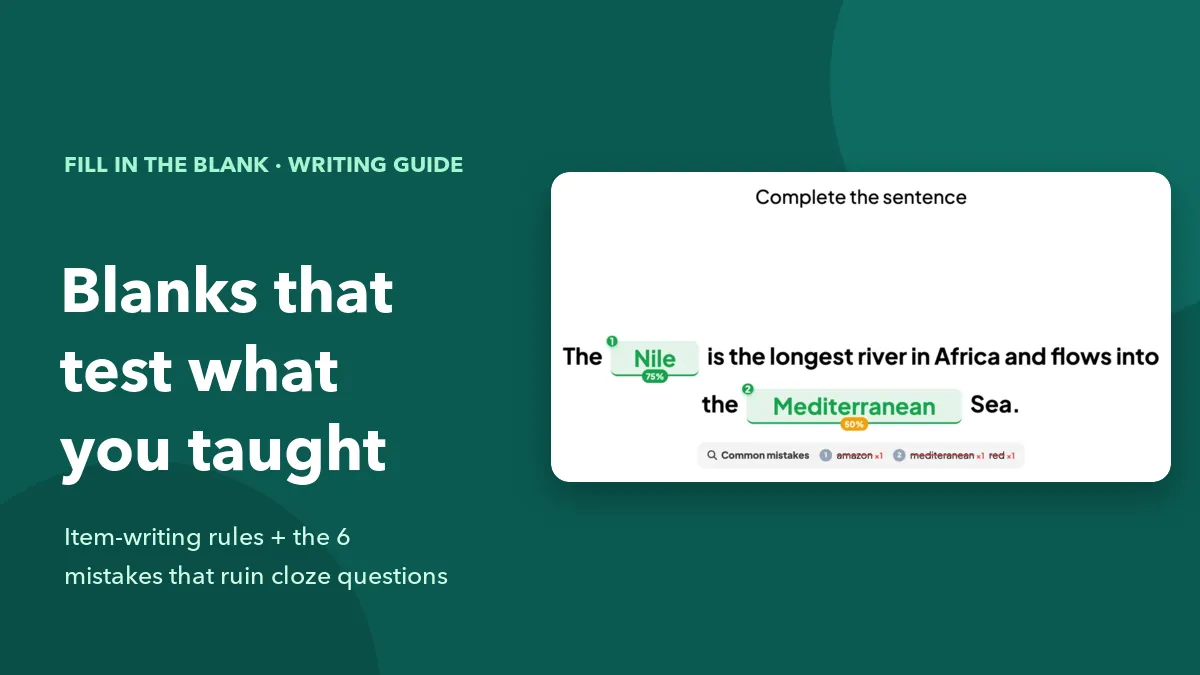
A fill in the blank question looks like the easiest thing in the world to write: take a sentence, hide a word, done. That ease is exactly the problem. Most blanks that go wrong were written in ten seconds, and they end up testing grammar, guessing or patience instead of the idea you taught. This guide is about the writing itself: the rules that make a cloze question measure real understanding, the six mistakes that quietly ruin one, and how to use live results to fix the weak items before your next session.
What a good blank actually measures
A blank is a recall prompt. Unlike a multiple-choice option, there is nothing to recognise, so the learner has to retrieve the answer from memory. That retrieval effort is what makes the format valuable; the research on the testing effect shows that pulling information out of memory strengthens it far more than re-reading it. The classic cloze test was originally built to measure reading comprehension by deleting words at fixed intervals, but in a lesson or training session you want something more deliberate: every blank should sit on a word that only someone who learned the material would know.
So before you write anything, ask one question: "If someone fills this in correctly, what do I now know about them?" If the honest answer is "they know English grammar" or "they guessed well", the item needs rewriting.
Six rules for writing cloze questions
1. Start from a learning objective, not a sentence
Write down the fact, term or relationship you want people to remember, then build a sentence around it. Writing the sentence first and choosing a word to hide afterwards is how you end up blanking whatever looks convenient.
2. Blank the word that carries the meaning
Nouns, key terms, names, numbers and cause-effect words are usually the right targets. Articles, helping verbs and prepositions rarely are, unless the lesson is about them.
3. Leave enough context to make one answer inevitable
Someone who knows the topic should read the sentence and think of exactly one answer. Add a qualifier ("in the year", "the organelle where", "the policy that") whenever the sentence alone allows several sensible completions.
4. Put the blank near the end
Readers build an expectation as they read. A blank at the end of a sentence lets the full context work for them; a blank in the first two words forces people to read ahead and guess what kind of word belongs there.
5. Decide the accepted spellings before you present
List every answer you would mark correct, such as British and American spellings, plural forms and common abbreviations. If you can't list them, the blank is probably too open.
6. Keep it to one to three blanks per sentence
Each extra blank removes context the others depend on. One well-chosen blank teaches more than four that leave a sentence full of holes.
The 6 most common mistakes (with rewrites)
Mistake 1: Blanking a filler word
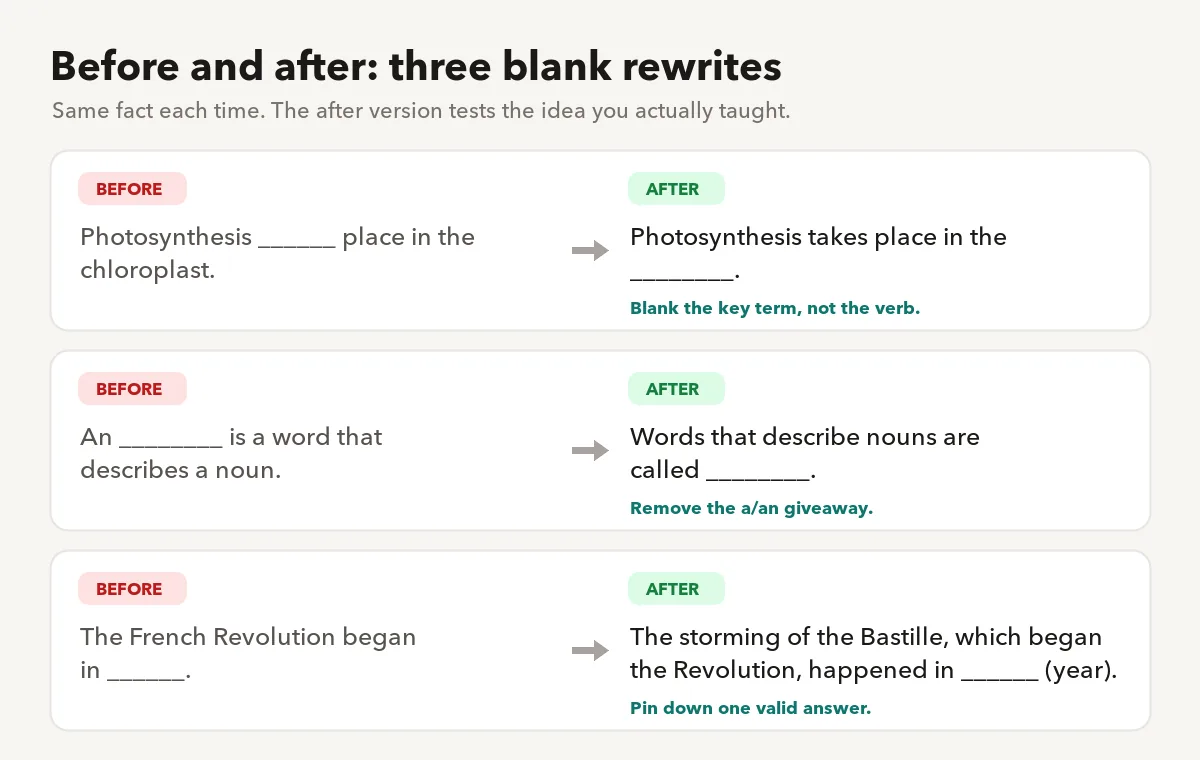
Before: "Photosynthesis ____ place in the chloroplast." The blank tests whether people know the phrase "takes place", not biology.
After: "Photosynthesis takes place in the ____." Now the answer, chloroplast, is the thing you taught.
Mistake 2: An ambiguous blank with many valid answers
Before: "The French Revolution began in ____." Is that 1789, France, Paris, the summer, or the 18th century? All are defensible, so your scoring becomes an argument.
After: "The storming of the Bastille, which began the French Revolution, happened in the year ____." The qualifier pins the answer to 1789.
Mistake 3: Too many blanks
Before: "The ____ carries ____ from the ____ to the ____." Even an expert has to guess which organ and which direction you mean.
After: "The pulmonary artery carries blood from the heart to the ____." One blank, full context, one correct answer: the lungs.
Mistake 4: Testing grammar instead of knowledge
Before: "Water ____ at 100 °C at sea level." People fight over "boils" versus "boil" versus "is boiling".
After: "At sea level, water boils at ____ °C." The number is the knowledge; the verb is given.
Mistake 5: The a/an giveaway
Before: "An ____ is a word that describes a noun." The word "an" tells everyone the answer starts with a vowel, which narrows the field for free.
After: "Words that describe nouns are called ____." No article, no hint. The same trap appears with singular and plural verbs, so check the words directly around every blank.
Mistake 6: Copying textbook sentences word for word
Lifting a sentence straight from the slides or the manual turns the question into a memory test for that exact wording. People who memorised the phrase pass and people who understood the idea in their own words can fail. Paraphrase the sentence so the only way to fill the blank is to know the concept. The exception is when exact wording is the point, such as a safety rule or a legal definition.
A good blank has exactly one answer, and that answer is the idea you taught. Everything else in the sentence exists to make that answer inevitable for someone who learned it.
Writing fill in the blank questions in EngageSlide
In EngageSlide, fill in the blank is a quiz question type, so it scores points and feeds the leaderboard like any other quiz slide. Writing one takes a minute:
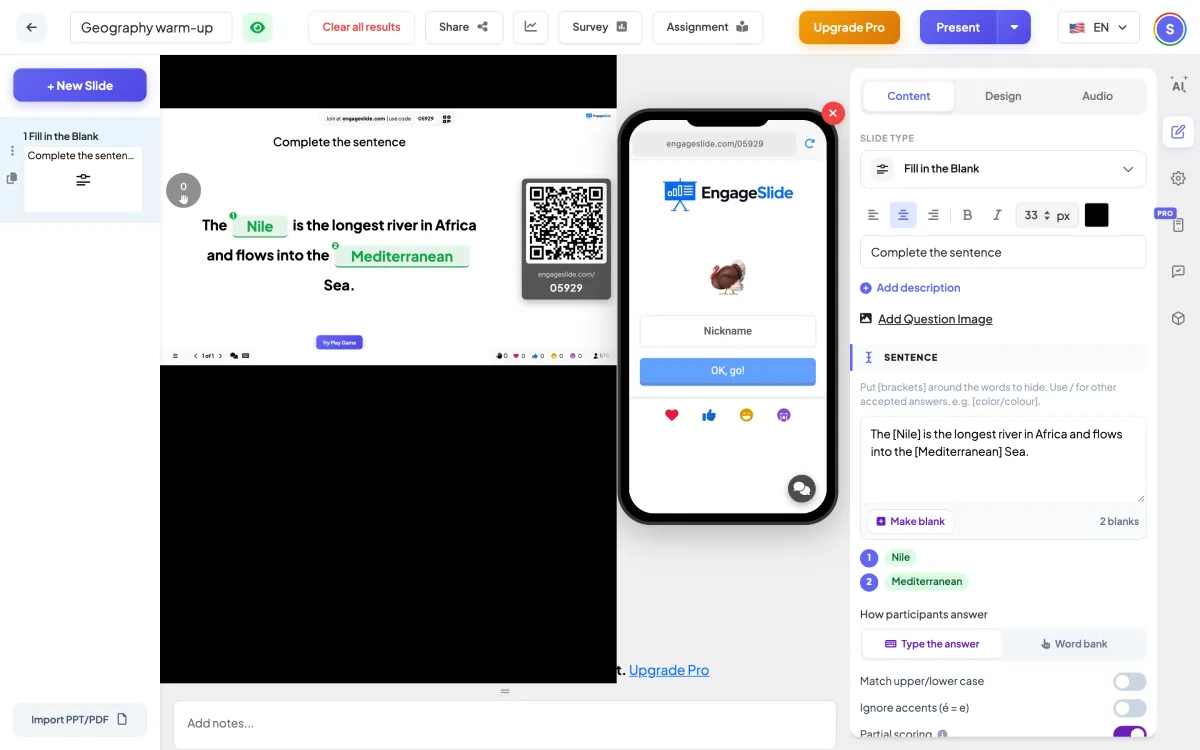
- Type the sentence and bracket the hidden words. "The [Nile] is the longest river in Africa." You can also select a word and press Make blank. Each sentence supports up to ten blanks, but the rules above still apply.
- Add accepted alternatives with a slash. "[color/colour]" or "[UK/United Kingdom]" marks every listed form as correct. This is where rule 5 pays off.
- Choose how people answer. In Type the answer mode participants type each word, which is true recall. In Word bank mode they tap words from a shuffled bank, and you can add extra wrong words as distractors. Use the word bank when spelling isn't the point, for younger learners, or for long technical terms people would struggle to type on a phone.
- Set the matching rules. Matching is not case-sensitive by default, you can choose to ignore accents so "é" counts as "e", and stray punctuation such as a trailing full stop is ignored. Partial scoring gives credit for each correct blank instead of all-or-nothing, which is fairer on two- and three-blank sentences.
You can run it inside any session built with the EngageSlide interactive presentation tool, including from PowerPoint or Google Slides. For the full walkthrough of setting up and presenting the question type, see our guide to the fill in the blank quiz game.
Use the results to fix weak items
Writing doesn't end when you press Present. When the timer runs out, EngageSlide reveals the correct words in place, shows the percentage of people who got each blank right, and lists the most common wrong answers for every blank. That panel is free item analysis, so read it with the six mistakes in mind:
- Lots of different wrong answers that are all reasonable. The blank is ambiguous (mistake 2). Add a qualifier or accept the alternatives.
- The same misspelling again and again. People know the idea but not the spelling. Add the variant with a slash, or switch to word bank mode if spelling isn't what you're assessing.
- Nearly 100% correct on a hard topic. Something is giving the answer away, such as an article, a plural verb or a sentence copied from the slide people just saw.
- One blank far lower than the others. That is either the real misconception in the room, which is worth five minutes of teaching right now, or a blank that depends on the one before it.
Edit the sentence after the session and the next group gets a better question. Over a term or a training programme, this is how a quiz bank goes from "fine" to genuinely diagnostic.
A quick checklist before you present
- Objective. Can you name the fact each blank tests?
- One answer. Would two experts fill it in the same way?
- No giveaways. Check the article and verb right next to every blank.
- Alternatives listed. Spellings, plurals and abbreviations are separated with slashes.
- Light on blanks. One to three per sentence, placed near the end.
- Paraphrased. The sentence isn't copied from the slide people just read.
If you teach language, our post on teaching vocabulary with fill in the blank quizzes applies these rules to word lists and verb forms. Take three sentences from your next lesson, run them through the checklist, and let the reveal tell you which ones still need work.