
You can own the best live polling tool in the world and still get useless results if the question is wrong. The way you word a poll quietly steers how people answer — nudge them one direction and the "data" you collect just reflects your own assumptions back at you. If you want feedback you can actually trust, the question matters more than the platform. This guide breaks down exactly how to write poll and survey questions that get honest answers, with clear before-and-after examples you can copy into your next session.
Why most poll questions quietly fail
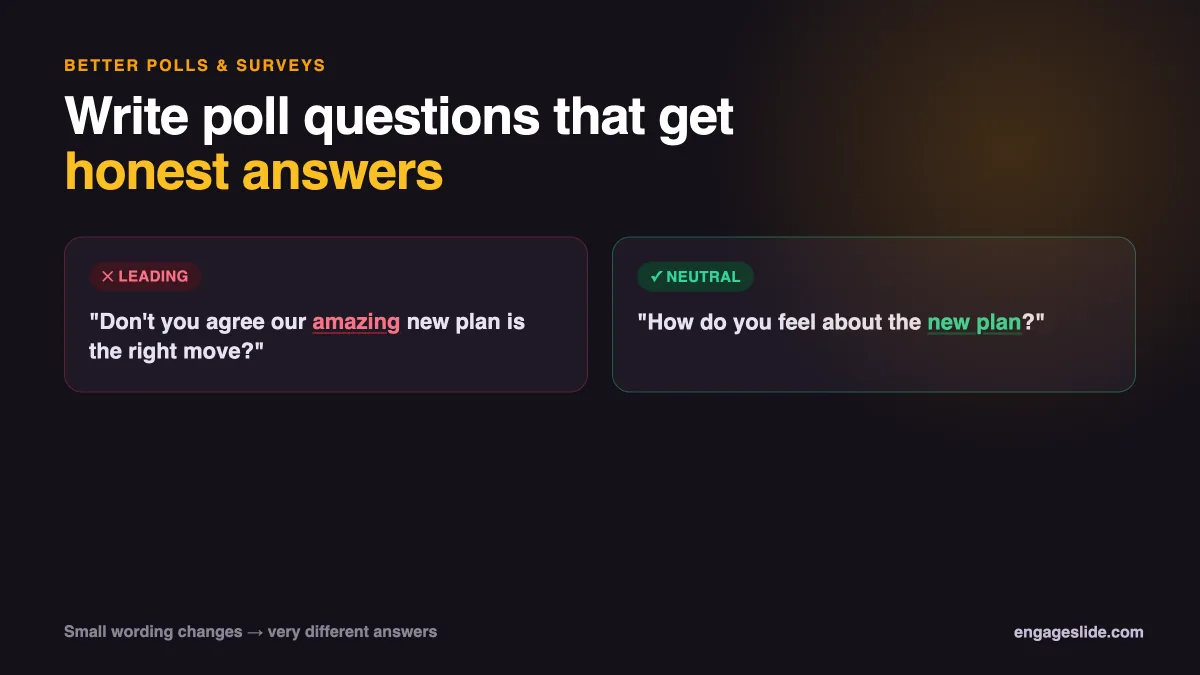
A poll question fails when it shapes the answer before anyone taps a button. The classic culprit is the leading question — one that hints at the "correct" response. Ask "Don't you agree our new plan is a great step forward?" and you'll get a wall of agreement that tells you nothing, because the wording made disagreement feel awkward.
The broader problem is response bias: any systematic way that question design pushes answers away from the truth. Leading language, loaded words, unbalanced scales, and questions that are simply confusing all bend your results. The good news is that a handful of simple rules eliminate almost all of it.
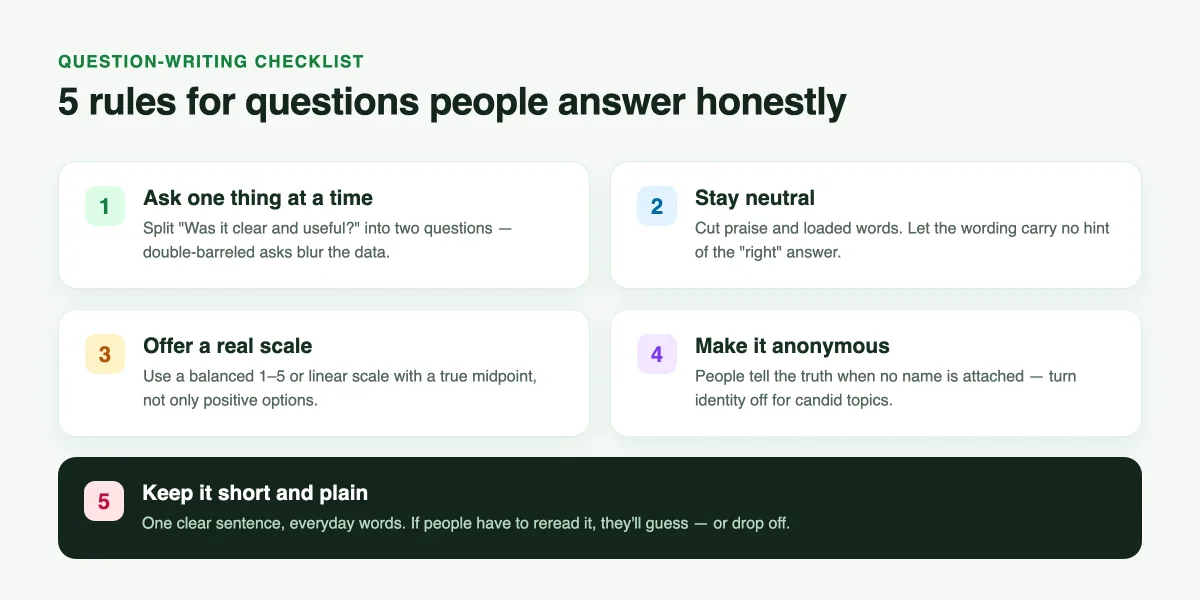
The 5 rules for questions people answer honestly
Keep these five principles in front of you every time you write a poll. Each one removes a common source of bias.
1. Ask one thing at a time
A "double-barreled" question smuggles two ideas into one answer. "Was the session clear and useful?" leaves someone who found it clear but useless with no honest option. Split it: one poll for clarity, one for usefulness. Each result is then clean and actionable.
2. Stay neutral
Strip out praise, judgment, and loaded adjectives. "How do you feel about the new plan?" invites a real opinion; "How excited are you about our exciting new plan?" pre-loads the answer. A neutral question offers no clue about which response you're hoping for — and that's exactly when people tell you the truth.
3. Offer a real scale
When you use a rating question, make the scale balanced. A proper Likert scale runs from one extreme to the other with a true midpoint — for example, "Very dissatisfied → Very satisfied" across five points. Avoid scales that only offer shades of positive ("Good, Great, Amazing"), which quietly forbid criticism. EngageSlide's linear-scale and rating questions give you an even, honest spread to work with.
4. Make it anonymous
People edit themselves when their name is attached — especially on sensitive topics like management, workload, or "did this training actually help?" Anonymity is the single biggest unlock for candor. In EngageSlide you can collect responses without identity, so participants say what they really think instead of what they think you want to hear.
5. Keep it short and plain
One clear sentence in everyday language. If people have to read a question twice, some will guess and others will drop off — both corrupt your data. Cut jargon, cut clauses, and cut any word that isn't earning its place. Short questions get more responses and more accurate ones.
Every word in a poll question is a nudge. Honest data comes from questions that nudge in no direction at all.
Before and after: fixing real questions
Rules are easier to trust when you see them applied. Here are common questions rewritten for honesty:
- Leading → Neutral. "Wasn't the keynote inspiring?" becomes "How would you rate the keynote?" on a 1–5 scale.
- Double-barreled → Single. "Was the venue easy to reach and comfortable?" becomes two questions: one on getting there, one on comfort.
- Vague → Specific. "Did you like the workshop?" becomes "How confident do you feel applying what you learned today?"
- Unbalanced → Balanced. Options "Great / Good / Okay" become a full "Very poor → Very good" five-point scale so criticism has somewhere to land.
Match the question type to what you're asking
Honest answers also depend on giving people the right format. A yes/no question can't capture nuance; an open text box can overwhelm a live audience. As a rule of thumb:
- Multiple choice for clear, mutually exclusive options.
- Linear scale for intensity — satisfaction, confidence, agreement.
- Ranking when you need priorities in order, not just a single winner.
- Open-ended or word cloud when you genuinely want people's own words — and are ready to read them.
EngageSlide's online survey maker gives you nine question types, so you can pick the format that fits the question instead of forcing every question into the same mold. You can run these live during a talk or send them as a standalone survey afterward.
Give people permission to be critical
Even a perfectly neutral question can get polite, inflated answers if the room feels like criticism isn't welcome. A little framing fixes this. Before an anonymous feedback poll, say it plainly: "This is anonymous, and honest low scores help me more than kind high ones." That single sentence signals safety and measurably widens the range of responses you get.
It also helps to include a genuine "escape" option where one fits — "Not sure," "Didn't apply to me," or "Prefer not to say." Forcing everyone into a stance they don't hold manufactures fake certainty. Letting people opt out honestly keeps the answers that do land far more trustworthy, and it stops undecided participants from picking a random option just to move on.
Test your questions before you go live
One last habit separates good polls from great ones: read every question out loud before you use it, and ask yourself two things — "Could someone guess which answer I want?" and "Could two people read this differently?" If the answer to either is yes, rewrite it. Better still, show it to one colleague; if they hesitate, your audience will too.
Great questions are the foundation everything else rests on. Once your wording is neutral, single-minded, and short, your live polls stop flattering you and start informing you. If you're new to running polls in the first place, start with our beginner's guide to live polling, then come back to sharpen your questions. And for more ways to gather candid input in real sessions, see how teams use real-time engagement with live polling. Explore more practical guides on the EngageSlide blog.